Showing posts with label Thoreau. Show all posts

Tuesday, January 28, 2014

Thoreau - The end of innocence

I wrote a little bit about my American literary idol, Henry David Thoreau (apparently born David Henry Thoreau) a few months ago. I was sure I had posted this follow up, but apparently not.  All I really did was quote from his journals (I found a book which made a pithy summary of his volumes of notes) and make my own comments beside him, but, I was glad to do it. I am mesmerized by and even envy his writing ability which is entirely modern and at the same time both feathery light and filled with gravitas. Of the 19th century American writers I can think of only Lincoln and Twain that were in his league (and though Lincoln was a speech writer, some of Thoreau's best known works were actually speeches, such as what is known as Civil Disobedience).  His philosophy is often my philosophy, but (like almost everyone) he is more of a purist than I am.  Sometimes I wonder if he isn't drawn to ideas by his own circumstances or shortcomings and in the last post about him I considered some of the mild - really mild - demerits against him.  But, if the worst you can find to say negative about this unusual, literary, courageous, wise and experimental man is that when he was young he emulated a more famous man in his own circle, and had the condescending view of women so typical of his time (and for a long time thereafter), then you are really saying something quite positive about his character.

He was born in 1817. To put it in perspective - a number of the founding fathers were still alive and had quite a ways to go - Adams, Jefferson, Madison, Monroe and the much maligned Burr, to name some.  He was a little younger than Lincoln and died less than a hundred years before I was born, which shows you how short our history really is.  America was in the upswing after the War of 1812 and would be at peace with other large countries for most of his life - the Mexican War, of which he greatly disapproved when he was shy of 30 and then the Civil War as his life ended in 1962, were exceptional.

He is many things - a transcendentalist (see Wikipedia, if you want) foremost, a naturalist, a moralist, a philosopher and a champion of the common man, to name a few things.  I started to see a difference in his journal starting in 1856. More and more he seemed to be caught up with some bitterness concerning his friends and lack of love in his life. However much he must have treasured nature walks or floats, it had to be lonely sometimes. In any event, as he approached or was in middle age, he seemed to get crankier to me.

As the last time, the following are some of his journal entries and my comments:

___________

The papers are talking about the prospect of a war between England and America. Neither side sees how its country can avoid a long and fratricidal war without sacrificing its honor. . . .

It is not hard to imagine that after the Revolutionary War Britain and America remained at best suspicious competitors and at worst bitter enemies before friendship came. And that came long after Thoreau was dead. The War of 1812 ended not long before he was born and even in the Civil War, during which conflict Thoreau perished, the two countries were often at loggerheads and London considered entering the fray on the Confederacy's side. But that was the highest point of disaffection. Sometimes issues arising as a result of the shared border with Canada, then British, also caused friction. But, at the same time, after 1815 there was a slow simmering as they saw they often had more in common than in opposition and negotiated settlements until during Roosevelt's terms a close friendship solidified and eventually became known as the special relationship. You would have difficulty finding what Thoreau was talking about online without resorting to newspaper archives. In fact, the problem surrounded the British seeking recruits on American soil for the Crimean War and a dispute involving British intrigues in Central America. We don't really hear about it anymore because it was a bump on a log. Nevertheless, for a while there was for a  discussion of war, which I do not believe many took seriously, particularly the two governments.

I had two friends. The one offered me friendship on such terms that I could not accept it without a sense of degradation. He would not meet me on equal terms, but only be to some extent my patron. He would not come to see me, but was hurt if I did not visit him. He would not readily accept a favor, but would gladly confer one. He treated me with ceremony occasionally, though he could be simple and downright sometimes; and from time to time acted a part, treating me as if I were a distinguished stranger; was on stilts, using made words. Our relation was one long tragedy, yet I did not directly speak of it. I do not believe in complaint, nor in explanation. The whole is but too plain, alas, already. We grieve that we do not love each other, that we cannot confide in each other. I could not bring myself to speak, and so recognize an obstacle to our affection.

I had another friend, who, through a slight obtuseness, perchance, did not recognize a fact which the dignity of friendship would by no means allow me to descend so far to speak of, and yet the inevitable effect of that ignorance was to hold us apart forever.

Huh. So what is going on here?  Thoreau was 39, middle aged at the time. I am middle aged myself, and though older than he was, given greater longevity now, it's probably roughly comparable. And, I think I understand him.  I heard a comedian not so long ago talking about how people in their 50s think all their friends are crazy. It hit home with me. Many of my middle age friends think I'm crazy, think each other are crazy, and I think many of them are crazy. Not crazy as in they have a crazy belief - like ghosts or UFOs or that the U.S. government was involved in bringing down the Twin Towers, or crazy as in genuine lunatics (well, some) - but in general philosophy of life and daily activity stuff.  Maybe this is the way it has always been and will be. Without going all psych 101 on it, I have always been something of an Adlerian (who I tried to read this year; Oh my God - soooo boring) whose main thesis was that most, perhaps all psychological questions are dominated by feelings of inferiority. Why there seems to be an uptick when people enter their 50s may just be an illusion or some people's anecdotal experience, but it could have something to do with a loss of hormones, or feelings of vulnerability, increased illness and feebleness, etc.  In people of that age group it may be countered with financial security or status symbols, respect, etc.  Generally, of course, it is natural for us to want to be admired or thought well of, and that need is perhaps even beyond the powers of a stoic philosophy to truly counter.  But, like all things, there are matters of degree between people.  As I go through life and learn more and more about friends and family, it seems to me that Adler was mostly right.  I don't know if we are capable of judging ourselves along these lines anymore than we can see ourselves in an objective light about anything.

It is almost certain that in the first paragraph above Thoreau was discussing Emerson, who did mentor him, and who many noticed Thoreau emulated. Emerson was older and, during life, far more successful. Thoreau eventually chafed under Emerson's desire to continue that mentoring beyond where Thoreau felt they were equals or perhaps in light of Emerson's greater success and travels. It might be a little unfair of him as in certain ways, as - were there no Emerson, there would likely be no Walden. No Walden and we would likely never have heard of Thoreau.  The irony is, of course, long after their deaths, Thoreau by far eclipsed his great friend in fame and influence.  Nevertheless, their relationship and its difficulties is one many of us would recognize from personal experiences.  There is a book out there, My Friend, My Friend: The Story of Thoreau's Relationship With Emerson, which I do not know if I will ever read, though it might be interesting.   

As to the second quoted paragraph above, I do not know. I've dabbled a little in Thoreau biography this year, but no one stands out to certainly fit that bill. Manners and mores were different than now and I can't say what matter he might have seen that he would find beneath his dignity to speak to a friend about. It might be something we would laugh at today. It might be hygiene or homosexuality or even heterosexual attraction - almost anything.

Farewell, my friends, my path inclines to this side the mountain, yours to that. For a long time you have appeared further and further off to me. I see that you will at length disappear altogether. For a season my path seems lonely without you. The meadows are like barren ground. The memory of me is steadily passing away from you. I have faith that, in the definitive future, new suns will rise, and new plains expand before me, and I trust that I shall therein encounter pilgrims who bear that same virtue that I recognized in you, who will be that very virtue that was you. I accept the everlasting and salutary law, which was promulgated as much that spring that I first knew you, as this that I seem to lose you.


My former friends, I visit you as one walks amid the columns of a ruined temple. You belong to an era, a civilization and glory, long past. I recognize still your fair proportions, notwithstanding the convulsions we have felt, and the weeds and jackals that have sprung up around. I come here to be reminded of the past, to read your inscriptions, the hieroglyphics, the sacred writings. We are no longer the representatives of our former selves.

We all have falling outs with friends, but the rest of us don't know how to put it so eloquently.  This was likely the Emersons too, though no one knows. As I read it I get more and more interested in My Friend, My Friend.

And now another friendship is ended. I do not know what has made my friend doubt me, but I know that in love there is no mistake, and that every estrangement is well founded. But my destiny is not narrowed, but if possible the broader for it. The heavens withdraw and arch themselves higher. I am sensible not only of a moral, but even a grand physical pain, such as gods may feel, about my head and breast, a certain ache and fullness. This rending of a tie, it is not my work nor thine. It is no accident that we mind; it is only the awards of fate that are affecting. I know of no æons, or periods, no life and death, but these meetings and separations. My life is like a stream that is suddenly dammed and has no outlet; but it rises the higher up the hills that shut it in, and will become a deep and silent lake. Certainly there is no event comparable for grandeur with the eternal separation--if we may conceive it so--from a being that we have known. I become in a degree sensible fo the meaning of finite and infinite. What a grand significance the word never" acquires! With one with whom we have walked on high ground we cannot deal on any lower ground ever after. We have tried for so many years to put each other to this immortal use, and have failed. Undoubtedly our good genii have mutually found the material unsuitable. We have hitherto paid each other the highest possible compliment; we have recognized each other constantly as divine, have afforded each other that opportunity to live that no other wealth or kindness can afford. And now, for some reason inappreciable by us, it has become necessary for us to withhold this mutual aid. Perchance there is none beside who knows us for a god, and none whom chance there is none beside who knows us for a god, and none whom we know for such. Each man and woman is a veritable god or goddess, but to the mass of their fellows disguised. There is only one in each case who sees through the disguise. That one who does not stand so near to any man as to see the divinity in him is truly alone. I am perfectly sad at parting from you. I could better have the earth taken away from under my feet, than the thought of you from my mind.

Holy cow! What is going on with my literary idol? What pathos! What ego!

I say in my thought to my neighbor, who was once my friend, "It is of no use to speak the truth to you, you will not hear it. What, then, shall I say to you?" At the instant that I seem to be saying farewell forever to one who has been my fined, I find myself unexpectedly near to him, and it our very nearness and dearness to each other than gives depth and significance to that forever. Thus I am a helpless prisoner, and these chains I have no skill to break.  While I think I have broken one link, I have been forging another.

We all have thoughts about people we are speaking to that we don't say aloud. But, this sounds exhausting. Yet, I do know people who obsess like this. About this point I started getting sorry I read his inner thoughts.

I have not yet known a friendship to cease, I think. I fear I have experienced its decaying. Morning, noon, and night, i suffer a physical pain, and aching of the breast which unfits me for my tasks. It is perhaps most intense at evening. With respect to Friendship I feel like a wreck that is driving before the gale, with a crew suffering from hunger and thirst, not knowing what shore, if any, they may reach, so long have I breasted the conflicting waves of this sentiment, my seams open, my timbers laid bare. I float on Friendship's sea simply because my specific gravity is less than its, but no longer that stanch and graceful vessel that careered so buoyantly over it. My planks and timbers are scattered. At most I hope to make a sort of raft of Friendship, on which, with a few of our treasures, we may float to some firm land.

Oh my God! Get therapy! What a drama queen.

That aching of the breast, the grandest pain that man endures, which no ether can assuage.

I have to stop reading this.

If I should make the least concession, my friend would spurn me. I am obeying his law as well as my own.

I think he's gone crazy.

. . . the sight of a marsh hawk in concord meadows is worth more to me than the entry of the allies into Paris. In this sense I am not ambitious. I do not wish my native soil to become exhausted and run out through neglect. Only that travelling is good which reveals to me the value of home and enables me to enjoy it better. That man is the richest whose pleasures are the cheapest.

The second to last sentence strikes me as something I have myself thought while on the road (or plane). The last sentence is, for me,  wisdom that speaks to life's central meaning.  If I could do one thing for my friends and family, it would be to pass on to them that notion. I don't really try because, it will almost certainly get me in trouble.  They will have to march to their own drummer too.

. . . I seek acquaintance with Nature--to know her moods and manners. Primitive Nature is the most interesting to me.  I take infinite pain to know all the phenomena of the spring, for instance, thinking that I have here the entire poem, and then, to my chagrin, I hear that it is but an imperfect copy that I possess and have read, that my ancestors have torn out many of the first leaves and grandest passages, and mutilated it in many places. I should not like to think that some demigod had come before me and picked out some of the best of the stars. I wish to know an entire heaven and an entire earth. All the great trees and beasts, fishes and fowls are gone. The streams, perchance, are somewhat shrunk.

Here too there seems wisdom, but perhaps that is an illusion of its eloquence. Like Bruce Lee said of old Chinese sayings, they sounded better before you started to think about them.  This one strikes me as Emersonian in its message. But, whereas I frequently agree with Thoreau, I frequently find Emerson the possessor of rose colored glasses, which, in the end, do not work so well.  What troubles me is the craving to seek and impossibility of knowing anything entirely.  I recognize it well and have probably held myself back in life because of a feeling I needed to know everything before I entered a particular fray.  But, this cannot always be and we are better off realizing there are limits to what we can know.  In my experience, you have to pick and choose your problems and try to solve them. We might reach expertise in this and that - some more than others, but to seek to know something in its entirety, even oneself, is a delusion and obsession.  On the other hand, if you sit on your hands waiting for enlightenment with everything, you will accomplish little. As perhaps with most everything, there is a rule of reason for everything.

Love is a thirst that is never slaked. Under the coarsest rind, the sweetest meat. If you would read a friend aright, you must be able to read through something thicker and opaquer than horn. If you can read a friend, all languages will be easy to you. Enemies publicly declare themselves. They declare war. The friend never declares his love.

Now that one is just depressing. And dumb. None of it is true.  He should have written about squirrels or rivers or sunsets that day.

My themes shall not be far-fetched. I will tell of homely every-day phenomena and adventures. Friends! Society! It seems to me that I have an abundance of it, there is so much that I rejoice and sympathize with, and men, too, that I never speak to but only know and think of. What you call bareness and poverty is to me simplicity. God could not be unkind to me if he should try. I love the winter, with its imprisonment and its cold, for it compels the prisoner to try new fields and resources. I love to have the river closed up for a season and a pause put to my boating, to be obliged to get my boat in. I shall launch it again in the spring with so much more pleasure. This is an advantage in point of abstinence and moderation compared with the seaside boating, where the boat ever lies on the shore. I love best to have each thing in its season only, and enjoy doing without it at all other times. It is the greatest of all advantages to enjoy no advantage at all. I find it invariably true, the poorer I am, the richer I am. What consider my disadvantage, I consider my advantage. While you are pleased to get knowledge and culture in many ways, I am delighted to think that I am getting rid of them. I have never got over my surprise that I should have been born into the most estimable place in all the world, and in the very nick of time, too.

How often I think these things about simplicity, meaning, advantages, what makes us rich and poor and the incredible fortune of when and where we are born. How often do I wonder why he and I and few others, seem to love Winter - even when we are cold.

A man cannot be said to succeed in this life who does not satisfy one friend.

Okay. Maybe. I don't know. Just one? That's a success?  And who is he talking about really? Himself? Someone who disappointed him?

How rarely a man's love for nature becomes a ruling principle with him, like a youth's affection for a maiden, but more enduring! All nature is my bride.

Me too, me too. Except, I also am not crazy about getting dirty. What can I say? I'm not Thoreau.

Up and down the town, men and boys that are under subjection are polishing their shoes and brushing their go-to-meeting clothes. I, a descendant of Northman who worshipped Thor, spend my time worshipping neither Thor nor Christ; a descendant of Northmen who sacrificed men and horses, sacrifice neither men nor horses. I care not for Thor nor for the Jews. I sympathize not today with those who go to church in newest clothes and sit quietly in straight-backed pews. I sympathize rather with the boy who has none to look after him, who borrows a boat and paddle and in common clothes sets out to explore these temporary vernal lakes. I meet such a boy paddling along under a sunny bank, with bare feet and his pants rolled up above his knees, ready to leap into the water at a moment's warning. Better for him to read Robinson Crusoe than Baxter's Saints' Rest.

You don't have to be a Christian to admire Christ in many ways. And Thor, hard to find fault in him in our or Thoreau's time as his myth has little relevancy to most people. But, perhaps Thoreau just means that religion, stripped of humanism is not interesting to him. I can certainly agree when it comes to rituals, most of which I find deadly dull and get no inspiration, as with other mythological or religious aspects. As for his affection for the young man ready to leap into the water, I am not certain. Undoubtedly, it is something about spontaneity, sincerity and naturalism. Why a boy? Most girls grow up to be women, and leave behind their dolls in all but nostalgia - longing for a certain future. Boys - we will always be a little bit boys in some ways - at least we will long for it when long past it. You'll have to forgive the generalization.

To a philosopher there is in a sense no great and no small, and I do not often submit to the criticism which objects to comparing so-called great things with small. It is often a question which is most dignified by the comparison, and, besides, it is pleasant to be reminded that ancient worthies who dealt with affairs of state recognized small and familiar objects known to ourselves.

Yes, yes, yes!  I don't really see how that is one complete thought - but I really like both parts of it. How often that strikes me as I dabble.

For a man to pride himself on this kind of wealth, as if it enriched him, is as ridiculous as if one struggling in the ocean with a bag of gold on his back should gasp out, "I am worth a hundred thousand dollars!" I see his ineffectual struggles just as plainly, and what it is that sinks him.

Ummm. See it again and again. What a blessing, but what a curse wealth can be.

 . . . Men are the inveterate foes of all improvement. Generally speaking, they think more of their hen-houses than of any desirable heaven. If you aspire to anything better than politics, expect no coöperation from men. They will not further anything good. You must prevail of your own force, as a plant springs and grows by its own vitality.

No, he's wrong. But we do it slowly and sometimes it takes the rest of us a generation to get to the point those long before us came to more easily.

Preaching? Lecturing? What are ye that ask for these things? What do ye want to hear, ye puling infants? A trumpet-sound that would train you up to mankind, or a nurse's lullaby? The preachers and lecturers deal with men of straw, as they are men of straw themselves. Why, a free-spoken man, of sound lungs, cannot draw a long breath without causing your rotten institutions to come toppling down by the vacuum he makes. Your church is a baby-house made of blocks, and so of the state. It would be a relief to breathe one's self occasionally among men. If there were magnanimity in us, any grandeur of soul, anything but sects and parties undertaking to patronize God and keep the mind within bounds, how often we might encourage and provoke one another by a free expression! I will not consent to walk with my mouth muzzled, not till I am rabid, until there is danger that I shall bite the unoffending and that my bite will produce hydrophobia.

Interesting how he makes church and state equivalent and both beneath his own rights. That's American, in his view and in mine. Let all our rights fall first, before freedom of speech.   

It is no compliment to be invited to lecture before the rich Institutes and Lyceums. The settled lecturers are as tame as the settled ministers. The audiences do not want to hear any prophets; they do not wish to be stimulated and instructed, but entertained. They, their wives and daughters, go to the Lyceum to suck a sugar-plum. The little of medicine they get is disguised with sugar. It is never the reformer they hear there, but a faint and timid echo of him only. They seek a pastime merely. Their greatest guns and sons of thunder are only wooden guts and great-grandsons of thunder, who give them smooth words well pronounced from manuscripts well punctuated--they who have stolen the little fire they have from prophets whom the audience would quake to hear. They ask for orators that will entertain them and leave them where they found them.

Why does that give me the feeling he didn't think he was given enough speech making work, but that it went to others who gave people what they wanted? This is always the feelings of those who don't feel appreciated. 

All the community may scream because one man is born who will not do as it does, who will not conform because conformity to him is death--he is so constituted. They know nothing about his case; they are fools when they presume to advise him. The man of genius knows what he is aiming at; nobody else knows. And he alone knows when something comes between him and his object. In the course of generations, however, men will excuse you for not doing as they do, if you will bring enough to pass in your own way.

And, again, clearly talking about himself. See what I mean? Getting bitter.

When I hear the hypercritical quarrelling about grammar and style, the position of the particles, etc., etc., stretching or contracting every speaker to certain rules of theirs--Mr. Webster, perhaps, not having spoken according to Mr. Kirkham's rules--I see that they forget that expression shall be vital and natural, as much as the voice of a brute or an interjection: first of all, mother tongue; and last of all, artificial or father tongue. Essentially your truest poetic sentence is as free and lawless as a lamb's bleat. The grammarian is often one who can neither cry nor laugh, yet thinks that he can express human emotions. . . .

How I regret time wasted on excessive pickiness with this or that grammatical rule. But, is this not a matter of taste? Is this not the same thing we face everywhere - not one or the other, but how much of some?

Find out as soon as possible what are the best things in your composition, and then shape the rest to fit them. The former will be the midrib and veins of the leaf.

I don't know about the rest of you, but I will take Thoreau's advice on writing.

There is always some accident in the best things, whether thoughts or expressions or deeds. The memorable thought, the happy expression, the admirable deed are only partly ours. The thought came to us because we were in a fit mood; also we were unconscious and did not know that we had said or done a good thing. We must walk consciously only part way toward our goal, and then leap in the dark to our success. What we do best or most perfectly is what we have most thoroughly learned by the longest practice, and at length it falls from us without our notice, as a leaf from a tree. It is the last time we shall do it--our unconscious leavings.

I would have just said practice makes perfect, but that's why he gets the big bucks.

There was a remarkable sunset, I think the 25th of October. . . But it was hard for me to see its beauty then, when my mind was filled with Captain Brown. So great a wrong as his fate implied overshadowed all beauty in the world.

I wasn't there. But, I am sure I would have felt much the same. John Brown was a strange man and he could be a brutal one. But, he had the courage to give his life to fight something one hundred, one thousand, one million times more cruel. And got nothing for it but a noose and the rewards of posterity.

The old naturalists were so sensitive and sympathetic to nature that they could be surprised by the ordinary events of life. It was an incessant miracle to them, and therefore gorgons and flying dragons were not incredible to them. The greatest and saddest defect is not credulity, but our habitual forgetfulness that our science is ignorance.

So much so that I often think I can love scientists and philosophers who recognized it.

Talk about slavery! It is not the peculiar institution of the South. It exists wherever men are bought and sold, wherever a man allows himself to be made a mere thing or a tool, and surrenders his inalienable rights of reason and conscience. Indeed, this slavery is more complete than that which enslaves the body alone. It exists in the Northern States, and I am reminded by what I find in the newspapers that it exists in Canada. I never yet met with, or heard of, a judge who was not a slave of this kind, and so the finest and most unfailing weapon of injustice. He fetches a slightly higher price than the black men only because he is a more valuable slave.

I didn't know what he meant until I read the next paragraph.

It appears that a colored man killed his would-be kidnapper in Missouri and fled to Canada. the bloodhounds have tracked him to Toronto and now demand him of her judges. From all that I can learn, they are playing their parts like judges. They are servile, while the poor fugitive in their jail is free in spirit at least.

See.

It is true we as yet take liberties and go across lots, and steal, or "hook," a good many things, but we naturally take fewer and fewer liberties every year, as we meet with more resistance. In old countries, as England, going across lots is out of the question. You must walk in some beaten path or other, though it may [be] a narrow one. We are tending to the same state of things here, when practically a few will have grounds of their own, but most will have none to walk over but what the few allow them.

But most men, it seems to me, do not care for Nature and would sell their share in all her beauty, as long as they may live, for a stated sum--many for a glass of rum. Thank God, men cannot as yet fly, and lay waste the sky as well as the earth! We are safe on that side for the present. It is for the very reason that some do not care for those things that we need to continue to protect all from the vandalism of a few.

This came to me when I lived surrounded by rural fields and wilderness for a while, yet had to drive to get to anywhere to walk. Private property is wonderful, but I am a big fan of holding some land back for the public and were we better at it, such land would intertwine private property like a million snakes. As for most men not liking nature, probably more and more as we get the ability to more and more insulate ourselves from it. At least perhaps more and more we like it in small gulps to be experienced like a great movie.

A feeble writer and without genius must have what he thinks a great theme, which we are already interested in through the accounts of others, but a genius--a Shakespeare, for instance--would make the history of his parish more interesting that another's history of the world.

Whenever men have lived there is a story to be told, and it depends chiefly on the storyteller or historian whether that is interesting or not. You are simply a witness on the stand to tell what you know about your neighbors and neighborhood.

If you ever had a bad teacher in a good course, or a good one in a boring one, you know precisely what he means.  Of course, I do believe he is talking about himself again.

I can have enough even of renaissance art or reading Thoreau. Good night.

Saturday, October 26, 2013

Thoreau and the test of innocence.

Thoreau is one of my favorite topics here as he is in my reading and life. A search of my site revealed 21 previous posts in which I have mentioned him. In two of them, he is the or a major topic. In Thoreau Meets Me (7/31/08) the topic is pretty obvious, and Death Match: Thoreau v. Socrates (3/28/10) has been one of my most viewed posts for some reason or another; lately the most viewed.  In The Bare Necessities of Tao (6/2/08) he merited a section and on 3/19/10 his words accompany some photographs from the Blue Ridge Mountains which I lived near. In the rest of them, he is mentioned in passing or a quote.

Far as I can tell, like many writers, he writes often on the same themes. Every time I read him I am stunned anew by how much I have in common with him in interests and philosophically. I knew that the first time I read him (although I have always said I cannot remember if I just found a kindred soul or whether he deeply influenced me). The more I read him the more I find it so. Of course, he writes like a Greek earth god reborn in Massachusetts and my comparison ends with him there. On the other hand, he was dead almost a hundred years before I was born, so I get to comment on him, and not he on me. Heh heh heh.

I've also been delving just a bit into his life autobiographically and learned about the tiniest dents in his halo of integrity, but nothing that would really show him as being anything less than a secular saint.  But, for whatever it is worth, as for his "faults" it looks like he protested a little too much against travel and its benefits. Though I agree with him that "I am sure that what we observe at home, if we observe anything, is of more importance than what we observe abroad," he goes overboard with "[a] man can hardly travel without diminishing self-respect and independence there."  He rarely went far, a brief stay in Staten Island, once as far as Minnesota before he died, to Canada and a few other places.  But, he was an exhaustive travel reader himself.  Though he deserved it immeasurably, he is perhaps famous only because he lived near Emerson, a great man even in his own time, who respected him and sung his praises. But it was more than a two way street. We have the recollection of a few that Thoreau would emulate Emerson unconsciously in speech and expression almost comically, but without any awareness. I think he would be aghast at the suggestion.  It is perhaps more ennobling of him that the conjectured affair between he and Lidian Emerson, inevitably raised in our scandal seeking world and which easily could have happened as Emerson had him stay with the family when he took long travels, has not the slightest evidence to support it. His appreciation for a woman seemed mostly to be because she recognized his genius and listened to him.  I suspect he died a virgin and that is the consensus (suggestions of his homosexuality also seem similarly groundless). On the other hand, when you read some of his comments about women below, you do realize that he was still a man of his time.  Opinionated? Check. Condescending? Check. Narcissisitic? I don't know. He says that we all write about ourselves, whatever we think, and I usually agree.

But, that's enough smearing of perhaps the greatest writer in American history and a man who I believe understood the secrets of happiness more so than others. I'd rather show you what he wrote and make a few comments of my own. Thoreau wrote thousands of journal pages. Though he was school teacher, a pencil maker, a carpenter and a surveyor at various times in his life, it might be said that his true and unpaid profession was as a note taker. I just made myself laugh on finishing that sentence, realizing how much time I spend doing exactly the same thing. 

The words below come from a collection I bought called The Heart of Thoreau's Journals edited by Odell Shepard. Thoreau is in red and my comments are in black.

This shall be the test of innocence--if I can hear a taunt, and look out on this friendly moon, pacing the heavens in queen-like majesty, with the accustomed yearning. His stoicism is ancient, of course. The Greek philosopher Epictetus wrote "If you would improve, submit to be considered without sense and foolish with respect to externals." As I get older, and find myself subject to more criticism, I noticed that I have less patience with criticism which is not based on reality. Where once I would say nothing, now I say at least something, and immediately regret it. I'm not sure why. Perhaps the stoicism epitomized in Kipling's If:

If you can keep your head when all about you
  Are losing theirs and blaming it on you,
If you can trust yourself when all men doubt you,
  But make allowance for their doubting too;
If you can wait and not be tired by waiting,
  Or being lied about, don’t deal in lies,
Or being hated, don’t give way to hating,
  And yet don’t look too good, nor talk too wise

. . .

is a parlor game played with oneself and no more enlightening than waiting in line patiently for your bagel. I find that though I have tried to obtain Kipling's pedestal, sometimes I fail, and perhaps more and more. And those I know who either claim they have attained it one way or another (e.g., those who say, one way or another, "nothing bothers me") often seem the most sensitive.

As the least drop of wine tinges the whole goblet, so the least particle of truth colors our whole life. It is never isolated, or simply added as treasure to our stock. When any real progress is made, we unlearn and learn anew what we thought we knew before. I'm working on this one. Is it true or just a noble sounding fancy, that has the ring of truth without the bell?


The world is never the less beautiful though viewed through a chink or knot-hole. And, sometimes, it is more beautiful just because of the perspective.

The words of some men are thrown forcibly against you and adhere like burs. As Thoreau's do to me.

A man's life should be a stately march to a sweet but unheard music, and when to his fellows it shall seem irregular and inharmonious, he will only be stepping to a livelier measure, or his nicer ear hurry him into a thousand symphonies and concordant variations. There will be no halt ever, but at most a marching on his post, or such a pause as is richer than any sound, when the melody runs into such depth and wildness as to be no longer heard, but simplicity consented to with the whole life and being. He will take a false step never, even in the most arduous times, for then the music will not fail to swell into greater sweetness and volume, and itself rule the movement it inspired. Much like his most famous words, perhaps -- "If a man does not keep pace with his companions, perhaps it is because he hears a different drummer. Let him step to the music which he hears, however measured or far away." I find myself repeating (God, I hope not endlessly) that though I conform to 99% of my neighbors' conventions, the 1% off seems to drive people crazy.

I do not judge men by anything they can do. Their greatest deed is the impression they make on me. Some serene, inactive men can do everything. Talent only indicates a depth of character in some direction. We do not acquire the ability to do new deeds, by a new capacity for all deeds. My recent growth does not appear in any visible new talent, but its deed will enter into my gaze when I look into the sky, or vacancy. It will help me to consider ferns and everlasting. It sounds almost like sour grapes, but I think I get it (except for the line beginning "Talent only . . . ").  It seems a truism that because we cannot see inside others we are relegated to appreciate them only for what we can experience. I know that I have often baffled people by not seeming to care that they appreciate something I can do or have. It's not that it isn't nice to be complimented, and I remember the times I succumbed to praise almost as wounds, but I - maybe we - want people to appreciate us for who we are inside, though they would have to do so blindly, like a deaf bat feeling its way about a cavern roof (I'm just kidding with the last simile - playing Thoreau).

When I am going out for an evening I arrange the fire in my stove so that I do not fail to find a good one when I return, though it would have engaged my frequent attention present.  So that, when I know I am to be at home, I sometimes make believe that I may go out, to save trouble. And this is the art of living, too--to leave our life in a condition to go alone, and not to require a constant supervision. We will then sit down serenely to live, as by the side of a stove. This has been so much a part of my life, and so foreign to most people I know that I do not often try to explain it to them. Those who understand will read this and get it instantly.  For those who don't I say only that I admire those who can see past material things and who take the time to experience learning and their lives.

I think I will not trouble myself for any wealth, when I can be so cheaply enriched. Here I contemplate to drudge that I may own a farm--and may have such a limitless estate for the listening. All good things are cheap: all bad are very dear. It was difficult now for people to recognize this, and apparently just as difficult for others in his time. But, money's good too and he relied most of his life on the more traditional circumstances of his family. Perhaps the most wise course is that which an old girlfriend of mine used to say, which I think was hers uniquely - "Everything in moderation, but just a little bit more." 

I think I will not trouble myself for any wealth, when I can be so cheaply enriched. Here I contemplate to drudge that I may own a farm--and may have such a limitless estate for the listening. All good things are cheap: all bad are very dear. Pretty much the same sentiment as the one before.

The cheap piece of tinkling brass which the farmer hangs about his cow's neck has been more to me than the tons of metal which are swung in the belfry. He is choosing rural over urban, but really I can like both and never think which of the two I would like better. 

I must confess I have felt mean enough when asked how I was to act on society, what errand I had to mankind. Undoubtedly I did not feel mean without a reason, and yet my loitering is not without defense. I would fain communicate the wealth of my life to men, would really give them what is most precious in my gift. I would secrete pearls with the shellfish and lay up honey with the bees for them. I will sift the sunbeams for the public good. I know no riches I would keep back. I have no private good, unless it be my peculiar ability to serve the public. This is the only individual property. Each one may thus be innocently rich. I inclose and foster the pearl till it is grown. I wish to communicate those parts of my life which I would gladly live again myself. Although that could come across as a little bit conceited or narcissistic, what have you, I think I understand what he means. Thoreau does not feel that the business of America (or any country) should necessarily be business, as the saying goes.  Its business is in allowing each man and (though he barely seem to think them capable) woman to live their life enjoying the bounties of the earth and improving their minds and themselves as much as possible. He wanted us to love our work. You can see how this would not be very convincing to his neighbors who were heavily engaged in the hard, even grueling work of raising families, working farms or industry. You would not be wrong to say the world he lived in, the comforts and leisure he had, was the products of centuries of hard work by millions of people. No doubt. It is true, however, also for everyone else, and the degree to which they press themselves is determined, to some degree anyway, by them as well, at least in a free society. Unlike them, Thoreau was quite prepared to do without much that they required. I think in a nutshell, that is what his venture at Walden was all about. It was though, a very short experiment and a walk to mom's house.  

Of course, Thoreau was a voracious reader and intellectual. As many college grads were at the time, he was a linguist with Greek, Latin and all four of the major western European languages under his belt to various levels.  But he actually did conventional work and could be the most helpful to his fellows, competent at a multitude of tasks, including - pre-assembly line - making extremely high quality pencils, surveying properties and collecting specimens. He was a lecturer and a guardian of Emerson's family when he traveled.  He wrote in response to Harvard that  "I am a Schoolmaster--a Private Tutor, a Surveyor--a Gardener, a Farmer--a Painter, I mean a House Painter, a Carpenter, a Mason, a Day-Laborer, a Pencil-Maker, a Glass-paper Maker, a Writer, and sometimes a Poetaster."  

I don't want to write a complete essay on his economic philosophy here, but it is briefly and essentially, if not comprehensively spelled out in his little read but much cherished (by me and others, I'm sure) Life Without Principle.  It poses the question for us - had he not become famous after his death, through no efforts of his own, but only his brilliant writings, and was judged only on what he did and thought during his life, would we think he lived a full life with principle? Without claiming his talent, I share some of his sentiments expressed there and experience a tug of war between what society would have me do and what I would do if left to my own decision. I know what everyone else's answer is, but my answer begs to differ.  It seems to me his did too.

The really efficient laborer will be found not to crowd his day with work, but will saunter to his task surrounded by a wide halo of ease and leisure. There will be a wide margin for relaxation to his day. He is only earnest to secure the kernels of time, and does not exaggerate the value of the husk. Would the hen set all day? She can lay but one egg, and besides she will not have picked up materials for a new one. Those who work much do not work hard. This last phrase would not apply, I think, to those who love their job or what it provides them and their families - perhaps others? But, Thoreau would ask, what business do you have in a job that does not fulfill you? Of course, not many can do what Thoreau was capable of doing privately though undoubtedly there are others who just have not come to public renown. 

I do not prefer one religion or philosophy to another. I have no sympathy with the bigotry and ignorance which make transient and partial and puerile distinctions between one man's faith or form of faith and another's--as Christian and heathen. I pray to be delivered from narrowness, partiality, exaggeration, bigotry. To the philosopher all sects, all nations, are alike. I like Brahma, a Hari, Buddha, the Great Spirit, as well as God. I like all them all too, but only that part of each which is universal or I can find explained by a reverence for nature or a wonder at its bounty or which entertains me in the mythological or story. The adoration, ritual, dogma and solemnity which gives others comfort or at least companionship, he could not make sense out of at all. Nor I. Unlike Thoreau, I do not believe in a deity or creator at all. He seems to me to have believed deeply, and with a reverence far beyond those of many I see in my own time who address themselves to the form, but not the spirit of "their religion." 

What is peculiar in the life of a man consists not in his obedience, but his opposition, to his instincts. In one direction or another he strives to live a supernatural life. Maybe true. At least, in long term successful civilizations the men seem to realize they have to resist their worst desires and replace them with traditions that work.

As to conforming outwardly, and living your own life inwardly, I have not a very high opinion of that course.  And he spent a lot of time being criticized for it. When he died, many of his neighbors still saw him a ne'er do well and to a large extent, he them. His views let him no more than his neighbors understand that others having different needs or wants, or even the need to screw up in their own ways - by conforming or living their life inwardly.

Some circumstantial evidence is very strong, as when you find a trout in the milk.  I will someday, mark my words, given an opportunity, use this brilliant simile in a trial.

Perhaps I am more than usually jealous of my freedom. I feel that my connections with and obligations to society are at present very slight and transient. Those slight labors which afford me a livelihood, and by which I am serviceable to my contemporaries, are as yet a pleasure to me, and I am not often reminded that they are a necessity. So far I am successful, and only he is successful in his business who makes that pursuit which affords him the highest pleasure sustain him. But I foresee that if my wants should be much increased the labor required to supply them would become a drudgery. If I should sell both my forenoons and afternoons to society, neglecting my peculiar calling, there would be nothing left worth living for. I trust that I shall never thus sell my birthright for a mess of pottage.  He could repeat himself endlessly, and eloquently, much to the same point. I'm not Thoreau and will just shut up.

Men are very generally spoiled by being civil and well-disposed. You can have no profitable conversation with them, they are so conciliatory, determined to agree with you. They exhibit such long-suffering and kindness in a short interview. I would meet with some provoking strangeness, so that we may be guest and host and refresh one another. It is possible for a man wholly to disappear and be merged in his manners. The thousand and one gentlemen whom I meet, I meet despairingly, and but to part from them, for I am not cheered by the hope of any rudeness from them. A cross man, a coarse man, an eccentric man, a silent, a man who does not drill well--of him there is some hope. Your gentlemen, they are all alike. He takes his point too far here just to make it, but again, I know what he means. Only a brute or someone looking for ugly contention would desire rudeness with those who would debate him. Nor am I all that interested in those who immediately create of you a straw man and argue against what they imagine you believe, which is all too often the case, particularly with politics (and I have been occasionally guilty myself - it is an easy trap to fall into). And not every discussion need be long. Sometimes positions are obvious or easily stated in a sentence and not every disagreement need end in a debate. Undoubtedly though, there is a tipping point, perhaps as few as five or six people, where discussion ends and banter reigns (not that there's anything wrong with banter). The more people at a gathering the more politeness reigns out of fear that disagreement will lead to unpleasantness and spoil the party.  Franklin said that you could not readily convince anyone of anything in public debate and claimed not to try; just to ask questions. If he practiced what he preached, I lack his stoicism too. But, I'd like the opportunity and am willing to take the chance of disagreement from you.

May I love and revere myself above all the gods that men have ever invented. May I never let the vestal fire go out in my recesses.  Once again you could think this is narcissism or egotism. But, he is absolutely right. If you do not love yourself, why would you want to go on? Can humans like but not love themselves?  Those who take their own lives, whether from unfortunate circumstances out of their control or not, have for one reason or not decided they do not love themselves. Shakespeare knew it and wrote Hamlet, whose vacillation in view of the almost certain murder of his father by his mother and his brother, hesitated in taking vengeance, and loathed himself for it - which led to the To be or not be soliloquy. People who love an idea more than themselves may be great heroes or great villains, for they are more than willing to sacrifice themselves or others for it.  In fact, whether they see themselves as one or another is a matter of perspective. Hitler saw himself as a hero.

I fear that the character of my knowledge is from year to year becoming more distinct and scientific; that, in exchange for views as wide as heaven's cope, I am being narrowed down to the field of the microscope. I see details, not wholes nor the shadow of the whole. I count some parts, and say, "I know." It stopped me, but I am not quite sure I understand this. To quote Frodo, it would seem like wisdom but for the warning in my heart. Sometimes the only way to get know something is by the little pieces and to thereby form the entire framework in your head. I have a bad tendency to initially try to learn complicated things all at once, but it doesn't work. Knowledge must be learned bit by bit and never fully. Is this what he is saying or the opposite?

There is some advantage, intellectually and spiritually, in taking wide views with the bodily eye and not pursuing an occupation which holds the body prone. . . A man may walk abroad and no more see the sky than if he walked under a shed. . . Throw away a whole day for a single expansion, a single inspiration of air. Sounds nice. Even if you are working like the dickens, take a day, smell the roses and pay attention.

I omit the unusual--the hurricanes and earthquakes-and describe the common. This has the greatest charm and is the true theme of poetry.  You may have the extraordinary for your province, if you will let me have the ordinary. Give me the obscure life, the cottage of the poor and humble, the workdays of the world, the barren fields, the smallest share of all things, but poetic perception. Give me but the eyes to see the things which you possess.  Though he could work with exactitude, as in his surveying, he made it clear he was a poet, not a scientist. We all take what is readily visible to us and see it almost not at all, or as lacking any beauty. Sometimes it takes a great artist like Van Gogh to remind us how to look at the ordinary. One day I was looking at my ordinary orange colored tabby when I was a kid and suddenly realized, if I had never seen such a creature, and then saw a picture of her in a book, how remarkably colored I would find her. And my canary. And how beautifully arrayed pigeons and sparrows are if you really look at them with fresh eyes each time. When you make this a firm habit, any day where there are trees and clouds is remarkable and unique.

Is not the disease the rule of existence? There is not a lily pad floating on the river but has been riddled by insects. Almost every shrub and tree has its gall, oftentimes esteemed its chief ornament and hardly to be distinguished from the fruit. If misery loves company, misery has company enough. Now, at midsummer, find me a perfect leaf or fruit. The rule? No. But, one of two, like almost everything. It does seem to have an eastern flavor to it.

All perception of truth is the detection of an analogy; we reason from our hands to our head. 
Douglas Rich Hofstadter, a cognitive scientist whose father was a physicist, wrote a prize winning book in 1979 I will probably never read entitled Gödel, Escher, Bach: an Eternal Golden Braid. Though some loved it, it is apparently a lot of work to go through it; you need mathematical help and it is filled with puzzles. I'm not sure what you get out of it at the end except mental exercise, though the general ideas about consciousness, the meaning of "self" or "I" and artificial intelligence are plain enough. This year he has had published another book called Surfaces and Essences: Analogy as the Fuel and Fire of Thinking. He ar
gues there (I read the introduction) that analogy is central to thinking ("without analogies there can be no concepts"). But, of course, that's pretty much what Thoreau wrote long ago. Not that he invented the idea. The word "analogy" is itself ancient Greek and though I haven't studied it, I understand you can find a discussion of analogy as far back as Pythagoras. 

The obstacles which the heart meets with are like granite blocks which one alone cannot move. She who was as the morning light to me is now neither the morning star nor the evening star. We meet but to find each other further asunder, and the oftener we meet the more rapid our divergence. So a star of the first magnitude pales in the heavens, not from any fault in the observer's eye nor from any fault in itself, perchance, but because its progress in its own system has put a greater distance between. He and his brother actually competed over a woman. He stood aside for his sibling (who died quite young) and neither got her. Perhaps, though I doubt it, he loved Emerson's second wife, Lidian (originally, Lydia) as some speculate. Clearly he could yearn, but it looks like he did not let it get in the way of his life's mission, to describe his life in his hometown. Were his long walks in nature and his mellifluous outpouring of poetic descriptions of nature (which I do not share here, but could fill books) his distraction and projection, his armor for protection?

My friend will be bold to conjecture; he will guess bravely at the significance of my words. This actually how he ended that last paragraph. It lends some mystery to it. Could he have been talking about his friend Emerson or some other women's husband? Or was he referring to the woman himself? And what did it mean? That, I would guess, we will never know.

Today you may write a chapter on the advantages of travelling, and tomorrow you may write another chapter on the advantages of not travelling. The horizon has one kind of beauty and attraction to him who has never explored the hills and mountains in it, and another, I fear a less ethereal and glorious one, to him who has. That blue mountain in the horizon is certainly the most heavenly, the most  elysian, which we have not climbed, on which we have not caped for a night. But only our horizon is moved thus further off, and if our whole life should prove thus a failure, the future which is to atone for all, where still there must be some success, will be more glorious still. That covers a lot of ground. Let me dare to rewrite my literary hero in very prosaic terms - you can always argue things two ways; experience brings a different perspective and lessens the anticipation; anticipation heightens appreciation, but, if it does not pan out as we imagined, there is always the golden future to which we can look forward.  Okay, he said it better, but I think that's it.

Just sent a couple of hours (eight to ten) with Mary Emerson at Holbrook's. The wittiest and most vivacious woman that I know, that certainly that woman among my acquaintance whom it is more profitable to meet, the least frivolous, who will most surely provoke to good conversation and the expression of what is in you. She is singular, among women at least, in being really and perseveringly interested to know what thinkers think. She relates herself surely to the intellectual where she goes. It is perhaps her greatest praise and peculiarity that she, more surely than any other woman, gives her companion occasion to utter his best thought with hospitality, and is not prevented by any intellectuality in it, as women commonly are. In short, she is a genius, as whom I know. In that sense she is capable of a masculine appreciation of poetry and philosophy. I never talked with any other woman who I thought accompanied me so far in describing a poetic experience. Miss Fuller is the only woman I think of in this connection, and of her rather from her fame than from any knowledge of her. Miss Emerson expressed tonight a singular want of respect for her own sex, saying that they were frivolous almost without exception, that woman was the weaker vessel, etc.; that into whatever family she might go, she depended more upon the "clown" for society than upon the lady of the house. Men are more likely to have opinions of their own. This is Emerson's aunt who helped raise him and often lived with him. Thoreau's opinion of her seems quite a bit to depend on her view of him, that she lets him talk away (not that this should surprise) and of her opinion of women in general, in which she shares his less than admiring views. But, I'm not done with Thoreau and women.

In the evening went to a party. It is a bad place to go to--thirty or forty persons, mostly young women, in a small room, warm and noisy. Was introduced to two young women. The first one was as lively and loquacious as a chickadee; had been accustomed to the society of watering-places, and therefore could get no refreshment out of such a dry fellow as I. The other was said to be pretty-looking, but I rarely look people in their faces, and moreover, I could not hear what she said, there was such a clacking-could only see the motion of her lips when I looked that way. I could imagine better places for conversation, where there should be a certain degree of silence surrounding you, and less than forty talking at once. Why, this afternoon, even, I did better.  There was old Mr. Joseph Hosmer and I ate our luncheon of cracker and cheese together in the woods. I heard all he said, though it was not much, to be sure, and he could hear me. And then he talked out of such a glorious repose, taking a leisurely bite at the cracker and cheese between his words; and so some of him was communicated to me, and some to me to him, I trust.  Personally, I can understand how that last scene could be a delightful few hours, but there is room for both men and women in our lives. 

I confess that I am lacking a sense, perchance, in this respect, and I derive no pleasure from talking with a young woman half an hour simply because she has regular features. The society of young women is the most unprofitable I have ever tried. They are so light and flighty that you can never be sure whether they are there or not there. I prefer to talk with the more staid and settled, settled for life, in every sense. 

Frankly, other than being someone to hike with who could tell me what kind of tree that is over there, I'm not all that sure I would have liked him all that much once I had gotten to know him. Okay, that's enough, but it was fun. More Thoreau to come.


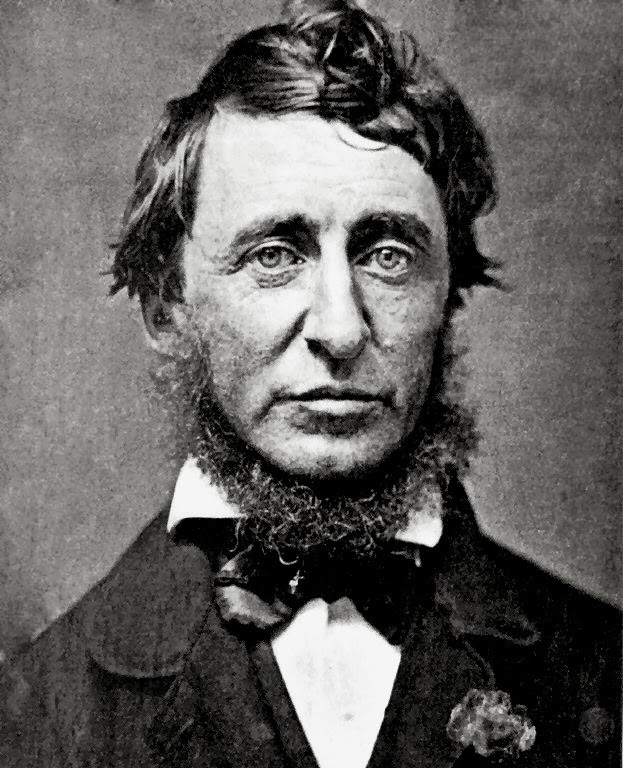
From the Wikipedia article. Portrait by Benjamin D. Maxham (daguerreotype) of Thoreau in 1856, just shy of his 39th birthday. Wikipedia says it might be copyrighted, so, so will I, but it seems like after 150 years or so, a copyright would have expired, no? 

Thursday, July 31, 2008

Thoreau meets me

Recently, I wrote here on the tao and Laozi, touching briefly upon Thoreau. I wrote little, expecting to cover him for more fully in his own post, and I keep that promise to myself here.

I’m not sure how my initial affinity for Thoreau happened exactly. It may just be because when I was young my mommy told me that I was named after him – only he was Henry David and I was David Henry. He was actually David Henry first, but just switched the names' places at some point for some unknown reason.  It was only really half true.  My middle name, Henry, was technically after my deceased Aunt Henrietta. Still, it may have had an effect on me.

I say this because by the time I got around to reading him, I had a strong sense of déjà vu, as if I had pre-cognition of what I would read and I can’t otherwise figure out how the hell that happened. I do not remember exactly when I first read Walden and Civil Disobedience, his two classics, either. However, since everything I can’t remember in my life seems to have occurred in the 70s and 80s, I'll go with that.

Thoreau is tied for second on my list of greatest American writers after Lincoln and with Twain. Although any list I have is subject to violent changes, this one is relatively stable.

The following is a series of quotes from Thoreau together with my commentary on my own connection to his thoughts. I admit to hesitating a little at my cheekiness in invading his space, because where I struggle and re-write just to make myself plain, he seemed to effortlessly write plainly in a script that glowed with gemlike aphorisms and wisdom. Not the purple prose of Oscar Wilde, but in earthier tones quite as beautiful. Yet, it is worth it to do this, because I get to quote him in droves, and that just plain makes me happy even if I corrupt it by comparing his thoughts to my own.

Besides, as writing about himself was exactly what Thoreau did, I have no doubt he would expect me to do the same. With journals containing over a million words, he would have been a natural blogger, as he understood well the primary topic of most blogs and wrote unconscientiously of what he knew best, himself:

I should not talk so much about myself if there were anybody else whom I knew as well. Unfortunately, I am confined to this theme by the narrowness of my experience.

Living here in my little rural town, trying to arrange a somewhat simpler way of life than I am used to (much harder than you think) and always uncomfortable with many modern technologies (clearly not some aspects of the internet, but cell phones, digital cameras, pagers, voice mail, flat tv’s and the like) Thoreau’s words are more attractive to me than ever. In fact, he so closely mirrors my thoughts about so many things, I wonder sometimes if I was read him while sleeping in my crib.

He starts his great classic, Walden, like so:

WHEN I WROTE the following pages, or rather the bulk of them, I lived alone, in the woods, a mile from any neighbor, in a house which I built myself, on the shore of Walden Pond, in Concord, Massachusetts, and earned my living by the labor of my hands only. I lived there two years and two months.

So plain and simple, it brings a homey and earthy image to the mind immediately that seems so desireable to me. Yet, even still, his friends seemed as puzzled about his decision to live alone in the woods more than a century and a half ago as many of my friends do now about my move to a rural community far from CVS and multiplexes. I can’t tell you how often I have heard something like the following:

I should not obtrude my affairs so much on the notice of my readers if very particular inquiries had not been made by my townsmen concerning my mode of life . . . Some have asked what I got to eat; if I did not feel lonesome; if I was not afraid; and the like.

I am as perplexed today at why some people were disapproving of my leaving a job that was pure misery for me, as Thoreau was at why his neighbors labored so hard for so little true satisfaction.

How many a poor immortal soul have I met well-nigh crushed and smothered under its load, creeping down the road of life, pushing before it a barn seventy-five feet by forty, its Augean stables never cleansed, and one hundred acres of land, tillage, mowing, pasture, and woodlot!

. . .

Most men, even in this comparatively free country, through mere ignorance and mistake, are so occupied with the factitious cares and superfluously coarse labors of life that its finer fruits cannot be plucked by them.

. . .

It is hard to have a Southern overseer; it is worse to have a Northern one; but worst of all when you are the slave-driver of yourself.

. . .

Public opinion is a weak tyrant compared with our own private opinion. What a man thinks of himself, that it is which determines, or rather indicates, his fate.

And perhaps the most famous of them all, which I find myself quoting to those I come upon who are unhappy and paralyzed by indecision, while knowing fully what they want:

The mass of men lead lives of quiet desperation.

Thoreau wondered out loud why people, once set on a path, find it so hard to change their direction. I wondered this about myself for quite a while until I started thinking - if not now, when?

It is never too late to give up our prejudices. No way of thinking or doing, however ancient, can be trusted without proof. What everybody echoes or in silence passes by as true today may turn out to be falsehood tomorrow, mere smoke of opinion, which some had trusted for a cloud that would sprinkle fertilizing rain on their fields.

. . .

In the long run men hit only what they aim at. Therefore, though they should fail immediately, they had better aim at something high.

I’m not so sure I agree with that last one, however well written. No doubt luck and happenstance has something to do with success. I also diverge from him in his following advice that our elders have little to offer us, but join him in believing that no advice, however venerable, need be worshipped as if it came down from a mountain.

I have lived some thirty years on this planet, and I have yet to hear the first syllable of valuable or even earnest advice from my seniors. They have told me nothing, and probably cannot tell me anything to the purpose. Here is life, an experiment to a great extent untried by me; but it does not avail me that they have tried it. If I have any experience which I think valuable, I am sure to reflect that this my Mentors said nothing about.

This did not stop him from quoting his distant seniors of whom he knew much.

Confucius said, "To know that we know what we know, and that we do not know what we do not know, that is true knowledge."

Although Thoreau thought each life an experiment, and that no other persons could guide you through yours with their own experiences, he also believed that if we could experience those lives uncensored and directly, no more valuable experience could be had.

What distant and different beings in the various mansions of the universe are contemplating the same one at the same moment! Nature and human life are as various as our several constitutions. Who shall say what prospect life offers to another? Could a greater miracle take place than for us to look through each other’s eyes for an instance? We should live through all ages of the world in an hour; ay, in all the worlds of the ages. History, poetry, mythology! I know of no reading of anothers experience so startling and informing as this would be.

He was by nature a more enthusiastic iconoclast than Twain (whose “Loyalty to petrified opinion never broke a chain or freed a human soul.” I wouldn't mind on my grave stone) and inspired anarchists and social reformers like King, Ghandi and Tolstoy alike:

The greater part of what my neighbors call good I believe in my soul to be bad, and if I repent of anything, it is very likely to be my good behavior. What demon possessed me that I behaved so well?

Thoreau did not believe that obtaining possessions, wealth or luxuries led to a happy life.

What is the nature of the luxury which enervates and destroys nations?

. . .

When I have met an immigrant tottering under a bundle which contained his all- looking like an enormous well which had grown out of the nape of his neck- I have pitied him, not because that was his all, but because he had all that to carry.

. . .

A lady once offered me a mat, but as I had no room to spare within the house, nor time to spare within or without to shake it, I declined it, preferring to wipe my feet on the sod before my door. It is best to avoid the beginnings of evil.

Yet, despite that, his reluctance to obtain possessions had its limits. He no more wanted to do without the improvements of life that his time permitted than I want to do without good ole American plumbing, electricity or heat.

Though we are not so degenerate but that we might possibly live in a cave or a wigwam or wear skins today, it certainly is better to accept the advantages, though so dearly bought, which the invention and industry of mankind offer.

Thoreau found the desire for fashion inexplicable. I have found that many of my heroes share this quality.

I say, beware of all enterprises that require new clothes, and not rather a new wearer of clothes.

. . .

Every generation laughs at the old fashions, but follows religiously the new.

. . .

The childish and savage taste of men and women for new patterns keeps how many shaking and squinting through kaleidoscopes that they may discover the particular figure which this generation requires today.

He was, however, no misanthrope. He believed in mankind in an almost pollyannish manner.

I know of no more encouraging fact than the unquestionable ability of man to elevate his life by a conscious endeavor.

On page after page Thoreau personally calls to me, and but for a lack of courage and my being completely incompetent to fend for myself in the wilderness, I would take greater risks in lowering my so called “standard of living” further still and possibly greatly expanding my enjoyment of life. I find the following description more attractive than all the millions in the world (unless it could buy me all of the following, of course).

I went to the woods because I wished to live deliberately, to front only the essential facts of life, and see if I could not learn what it had to teach, and not, when I came to die, discover that I had not lived. I did not wish to live what was not life, living is so dear; nor did I wish to practise resignation, unless it was quite necessary. I wanted to live deep and suck out all the marrow of life, to live so sturdily and Spartan- like as to put to rout all that was not life, to cut a broad swath and shave close, to drive life into a corner, and reduce it to its lowest terms, and, if it proved to be mean, why then to get the whole and genuine meanness of it, and publish its meanness to the world; or if it were sublime, to know it by experience, and be able to give a true account of it in my next excursion. For most men, it appears to me, are in a strange uncertainty about it, whether it is of the devil or of God, and have somewhat hastily concluded that it is the chief end of man here to "glorify God and enjoy him forever."

. . .

Simplicity, simplicity, simplicity! I say, let your affairs be as two or three, and not a hundred or a thousand; instead of a million count half a dozen, and keep your accounts on your thumb-nail.

Strolling through a used volume of Thoreau that I plucked from a box in the front of a used book store in order to get exact quotes, I am again struck with amazement at how so many of his pleasures are my pleasures, although I remembered it not, including a love of Homer. Here’s Thoreau on the classics.

[W]hat are the classics but the noblest recorded thoughts of man? They are the only oracles which are not decayed, and there are such answers to the most modern inquiry in them as Delphi and Dodona never gave. We might as well omit to study Nature because she is old. . . . No wonder that Alexander carried the Iliad with him on his expeditions in a precious casket. A written word is the choicest of relics. It is something at once more intimate with us and more universal than any other work of art. It is the work of art nearest to life itself. . . . The symbol of an ancient man's thought becomes a modern man's speech. Two thousand summers have imparted to the monuments of Grecian literature, as to her marbles, only a maturer golden and autumnal tint, for they have carried their own serene and celestial atmosphere into all lands to protect them against the corrosion of time. Books are the treasured wealth of the world and the fit inheritance of generations and nations. Books, the oldest and the best, stand naturally and rightfully on the shelves of every cottage. They have no cause of their own to plead, but while they enlighten and sustain the reader his common sense will not refuse them. . . .

Mostly, I love Thoreau for his description of nature and wish I could dwell in it as he does, with thorough knowledge and complete lack of fear. I indulge myself with hikes and kayak trips, which I pitifully try to describe to others and always feel I have failed. He shared my love for these same pastimes and described them in a manner that fills one with exhilarating wonder. Where I might bumbling write to a friend – “It snowed yesterday. You should have seen it. It was so pretty” – Thoreau wrote:

On this morning of the Great Snow, perchance, which is still raging and chilling men's blood, I bear the muffled tone of their engine bell from out the fog bank of their chilled breath, which announces that the cars are coming, without long delay, notwithstanding the veto of a New England northeast snow-storm, and I behold the plowmen covered with snow and rime, their heads peering, above the mould-board which is turning down other than daisies and the nests of field mice, like bowlders of the Sierra Nevada, that occupy an outside place in the universe.

Although famous now for his two major works, Thoreau actually wrote voluminously in his short life, including in a seemingly endless journal. He died during the civil war of respiratory complications from tuberculosis that had lingered for years.

There are multiple stories from Thoreau's last days and one wonders if he was trying to be quixotically or memorable. His aunt asked him if he had made his peace with God. He answered “I did not know that we had ever quarreled.” Nearer death, he was asked whether he believed in the afterlife, and responded, “Oh, one world at a time.” His last words are reportedly “Now comes smooth sailing”, and then the enigmatic and more often reported “Moose” and “Indian”.

For fun and with great confidence, I now open my volume of Thoreau, select a page and paragraph at random and type the lines I see:

When I was four years old, as I well remember, I was brought from Boston to this my native town, through these very woods and this field, to the pond. It is one of the oldest scenes stamped on my memory. And now tonight my flute has waked the echoes over that very water. The pines still stand here older than I; or, if some have fallen, I have cooked my supper with their stumps, and a new growth is rising all around, preparing another aspect for new infant eyes . . . .
Unfortunately for me, I know (and fear) I must soon find employment in the real and desperate world of work, most likely a 9-5 situation in an office, if anyone will have me, or suffer consequences more severe than I would like. I am not now and will never be quite ready to try the experiment Thoreau did. If I wanted to live one foot in this world and one in Thoreau's, I have no real choice. Were I to cut ties with the modern world, it would also cut ties with my daughter, my family and friends, the miracle of reading historical documents on the internet, flush toilets and reading at night. Those things I am just not willing to do without. Yet I must remember that Thoreau lived in his shack for only a little more than 2 years just a short walk to town and his mother’s house to which he would frequently go. I will be happy if I can stretch my own life in this rural community surrounded by natural parks and beauty for another year while enjoying all the modern comforts I seem to require, however meager they seem to others.

If I could somehow gently persuade those in the world who might gain from it to read Thoreau, I would. I have touched here upon only Walden and not his brilliant and inspirational short speech we call Civil Disobedience, his courageous literary defense of John Brown and abolition, his voluminous journals, or much about his life. Guided by my appreciation of anyone reading this far, I will not try your patience. But, if I have not persuaded you, I have persuaded myself to read Thoreau fully again, and, whenever possible, in a field or glen, by a lake, or sitting on my porch in a rainstorm.

I am giddy with anticipation. Giddy I tell you.

About Me

My photo
I started this blog in September, 2006. Mostly, it is where I can talk about things that interest me, which I otherwise don't get to do all that much, about some remarkable people who should not be forgotten, philosophy and theories (like Don Foster's on who wrote A Visit From St. Nicholas and my own on whether Santa is mostly derived from a Norse god) and analysis of issues that concern me. Often it is about books. I try to quote accurately and to say when I am paraphrasing (more and more). Sometimes I blow the first name of even very famous people, often entertainers. I'm much better at history, but once in a while I see I have written something I later learned was not true. Sometimes I fix them, sometimes not. My worst mistake was writing that Beethoven went blind, when he actually went deaf. Feel free to point out an error. I either leave in the mistake, or, if I clean it up, the comment pointing it out. From time to time I do clean up grammar in old posts as, over time I have become more conventional in my grammar, and I very often write these when I am falling asleep and just make dumb mistakes. It be nice to have an editor, but . . . .