Friday, November 29, 2013

The New Miss Malaprop III

It is never too soon for another New Miss Malaprop post (previous ones, definitely worth reading, posted on 4/26/07 and 6/1/12). These are the golden words of my immortal beloved, who frequently dazzles me with gem after gem. I do my best to copy them down as close as I can to the original words we both said. That isn't always easy, and might not be 100% accurate, but it is close enough.

I do realize that telling these may make me seem mean to some, or perhaps a pompous old geezer, but her tendency to malapropisms is really my favorite thing about her. We do have our tussles, but not about things like this. Of course, she thinks it's hysterical when I can't do a simple mechanical thing. Of course, she doesn't think it's funny when I forget . . . almost everything or can't fix anything (although I'm good at breaking most anything). Anyway, she only reads my blog in the hopes I mention her, so . . .

die mirabilis

Einstein had his annus mirabilis - year of miracles, when he wrote and published four ground breaking papers, including the most famous one on relativity (ironically, not the one for which he later won the Nobel Prize). The New Miss Malaprop recently had a die mirabilis - day of miracles, when we were visiting NYC and she spontaneously came out with these beauts.

We are in the car driving to New York City and she feels she has scored a point:

M[alaprop] : Really blew you out of the window that time.
D[avid]: Water.
M: What water?
D: The expression is "blew you out of the water," not "window."
M: Paper can blow out a window.
D: Uuuuh. . . yeah. That's still not the expression.

For some reason, she rarely seems to get that I am kidding around no matter how ridiculous the things that I say are. We've been doing it for 23 years. Sometimes, she concludes that I'm just an idiot to believe what I say. Next, we are still in the car and that commercial for 1-800 Cars for Kids with its unmistakable and catchy theme song comes on the radio. I can't help myself:

D: I don't understand this song.
M: It's about selling your car and donating it to kids.
D: Those aren't good lyrics. Who is it by?
M: You know, at some things you are very smart, but about things like this you are really stupid. It's a commercial.
D: Really? That can't be right.

Vocabulary is not her strong point. A little later, we wind up behind a vehicle with consular plates:

M: That must be a conciet?
D: What's a conciet?
M: Like in a hotel. The person who gets you things.
D: Oy.

We park the car and are walking near the Henry Hudson Parkway. Seeing a sign for it she says:
 

M: That's the Henry Hudson Parkway.
D: Do you know who he was?
M: Probably some guy from the Civil War.
D: Yes, that's exactly who he was. [obviously smirking]
M: Then he's probably some guy who died on that road and they named it after him.
D: Right. And then they named the river after the street, I guess.
M: Oh, right, the Hudson River. I guess I don't know who he was.
D: Do you want to know?
M: No, I really don't care.
D: Imagine my surprise.
 
A little while later we were taking a walk in Riverside Park. A couple passes going the other way speaking a foreign language:
 
M: Did you hear that? They are non-speaking English people.
D: I think you mean non-English speaking people.
M: Yes, non-Speaking English people.
D: No.  Non-English speaking people.
M: I know. That's what you just said.

After lunch, we are taking a leisurely walk back towards the car. We are at 101st St. heading towards 88th St.

D: Hmmm. I wonder how many blocks we have to go?
M: Probably about 20.
D: How do you manage?
M: Well, we are at 101st and we are going to 88th, so about 27.
D: You really can't do math, can you?
M: Not under pressure.
D: Oh, you are definitely under a lot of pressure.

At other times when I'm kidding, she realizes it, but it just makes her mad. I understand that even less than her not knowing I'm kidding. Nevertheless, at the end of the day, driving home while still in Manhattan, we pass a guy hailing a cab:

D: See, I told you people are signaling me.  That guy on the corner just waved at me.
M: What guy?
D: That guy on the corner there. See him waving his arm and looking down the road.
M: [Sneering] Please. He's not waving at you.

[A little later]

D: See, now that guy is signaling me?
M: Who?
D: That guy. He's standing by the curb holding his finger up. The one the cab just pulled up to.
M: [Angrily] I think you know perfectly well what that is. You just like to pretend.
D: [Sheepishly] No I don't.

The best of the rest

That was quite a day. The rest of these were made at other times. But, still funny. Like Gomez Addams, I love it when she speaks French.

M: Oh, well. C'est la vie.
D: Do you know what "c'est la vie" means?
M: [Cockily] Au revoir. Good bye.
D: Uh huh.

This next one is now one of my all time favorites. I was watching a football game on tv soon after the World Series ended, when: 

M: So, Boston lost?
D: No, Boston won.
M: So, why are you watching this?
D: What?
M: If there aren't any more games until the World Series?
D: What are you talking about? The series is over. Boston won.
M: You know, at the end of the year when they play the World Series and everyone watches it together.
D: Oh my God. How is it possible you know less about sports than anyone in the world? This is football. The Super Bowl is the last game of the season. It has nothing to do with the World Series. That's baseball. They're entirely different sports.
M: [Silence]
D: You're really embarrassed, aren't you?
M: Yeah.

In this next one she may have actually invented something when she saw my hair standing on end from static electricity:
 
M: You get all peacocked out.

Speaking of birds, one day while we were walking some geese were flying overhead, honking:

M: Listen - they're flying east.
D: (smiling at her)
M: West?
D: (Still smiling)
M: South?
 
And, last, showing off her knowledge of automobiles:
 
It was her Cadillac converter.

Of geography:

I love Baltimore. It’s a great state.
*
Where was it? London? England? One of those two places.

Of politics:

I'm voting for McRomney.

Of restaurant criticism:

They are really bobulated. (If you are having trouble there, she meant discom. . .)

Of philosophy - Don't ask me how this one came up. It's a long story]

A gym locker is the same as a house because they both have keys.

D: Sometimes your ethics amaze me.
M: I don't like all your ethnics either.

Of astronomy:

The moon just stands there but the sun goes round and round.

Of relationships - discussing a friend whose girlfriend thinks he is wonderful:

D: You never really thought that I was wonderful the way some women feel about their men.
M:  I don't think you are horrible.
D: Really? Can you put that on my tombstone? "He wasn't horrible."

Of popular sayings:

Don't pull my wool.

And lest you think these are dated in any way, let me just add one from last night. It is appropriate it happened on Thanksgiving, as I give thanks for these brilliant little malapropisms all the time.

It was further and morther.

Morther?

Sunday, November 24, 2013

Who said it XII?

I think I just did one of these Who said it? posts recently but I was flipping through a Will Durant volume this week, saw this first quote and said to myself, "Oh, who's counting? Do another." I have no idea if there have really been 12, but that's the number I'm up to whether it's accurate or not. But, just to change it up a little, in this one the answer is always someone who lived at least part of his/her life in the 17th century. My usual silly rule applies - I have to find the quote in my personal library. Why, you ask? The answer to almost all of the questions about decisions in my blog is  "Because it's my blog." And so for this.

1) Being of opinion that you endeavored to embroil me with women and by other means, I was so much affected that when one told me you were sickly and would not live, I answered, 'twere better if you were dead, I desire you to forgive me for this uncharitableness. For I am now satisfied that what you have done is just, and I beg your pardon for having hard thoughts of you for it, and for representing that you struck at the root of morality in a principle you laid down in your book of ideas, and designed to pursue in another book, and that I took you for a Hobbist.  I beg your pardon also for saying or thinking that there was a design to sell me an office, or to embroil me.

a) Thomas Hobbes    b) John Locke   c) Isaac Newton    d) Voltaire

2) In these four things, opinion of ghosts, ignorance of second causes, devotion towards what men fear, and taking of things casual for prognostications, consisteth the natural seed of religion, which, by reason of different fancies, judgments, and passions of several men, hath grown up into ceremonies so different, that those which are used by one man are for the most part ridiculous to another.

a) Thomas Hobbes    b) Isaac Newton   c) Baruch Spinoza    d) Jonathan Swift

3) After experience had taught me that all things that frequently take place in ordinary life are vain and futile; when I saw that all the things I feared, and which feared me, had nothing good or bad in them save in so far as the mind was affected by them, I determined at last to inquire whether there might be anything which might be truly good and able to communicate its goodness, and by which the mind might be affected to the exclusion of all other things.

a) Louis XIV          b) John Milton          c) Blaise Pascal          d) Baruch Spinoza

4) Why should anyone assert for you the right of free suffrage, or the power of electing whom you will to the Parliament? Is it that you should be able . . . to elect in the cities men of your faction, or that person in the boroughs, however worthy, who may have feasted yourselves most sumptuously, or treated the country people and boors to the greatest quantity of drink? Then we should have our members of Parliament made for us not by prudence and authority, but by faction and feeding; we should have vintners and hucksters from city taverns, and graziers and cattlemen from the country districts. Should one entrust the Commonwealth to those to whom nobody would entrust a matter of private business?

a) Oliver Cromwell     b) John Locke     c) John Milton   d) William Shakespeare

5) The various opinions of philosophers have scattered through the world as many plagues of the mind as Pandora's box did those of the body, only with this difference, that they have not left hope at the bottom. . . Truth is as hidden as the source of the Nile, and can be found only in Utopia.

a)  Oliver Cromwell   b) John Locke  c) Peter the Great   d) Jonathan Swift

6) What a Chimera is man! What a novelty, a monster, a chaos, a contradiction, a prodigy! Judge of all things, and imbecile norm of the earth; depository of truth, and sewer of error and doubt; the glory and refuse of the universe. Who shall unravel this confusion?

a) Charles II         b) RenĂ© Descartes       c) Blaise Pascal      d) Cardinal Richelieu

7) [I]n the compass of time, suffered so great a loss of light and heat by the continual emission of the corpuscles causing such phenomena, that they have become cold, dark, and almost powerless pulps. We find even that sun spots . . . increase in size from day to day. Now who knows if these are not a crust forming on the sun's surface from its mass that cools in proportion as light is lost, and if the sun will not become . . . an opaque globe like the earth?

a) Cyrano de Bergerac  b) Robinson Crusoe   c) Lemuel Gulliver    d) Samuel Pepys

8) God almighty first planted a garden; and, indeed, it is the purest of human pleasures. It is the greatest refreshment to the spirits of man, without which building and palaces are but gross handyworks; and a man shall ever see, that when ages grow to civility and elegancy, men come to build stately, sooner than to garden finely; as if gardening were the greater perfection.

a) Francis Bacon               b) King James        c) Martin Luther          d) Galileo Galilei

9) I hear new news every day, and those ordinary rumors of war, plagues, fires, inundations, thefts, murders, massacres, meteors, comets, spectrums, prodigies, apparitions, of towns taken, cities besieged in France, Germany, Turkey, Persia, Poland, etc., daily musters and preparations, and such like, which these tempestuous times afford, battles fought, so many men slain . . .  shipwrecks, piracies, and sea fights; peace, leagues, stratagems, and fresh alarms.  A vast confusion of vows, wishes, actions, edicts, petitions, lawsuits, pleas, laws, proclamations . . . opinions, schism, heresies . . . weddings, masquings, mummeries, entertainments, jubilees . . . burials . . . .

a)  Queen Elizabeth I      b) John Donne      c) Montaigne        d) Rembrandt          

10) Yesterday I received extreme unction, and today I pen this dedication. The time is short, my agony increases, hopes diminish. . . And so farewell to jesting, farewell my merry humors, farewell my gay friends; for I feel that I am dying, and have no desire but to see you happy in the other life.

a)  Cervantes      b)  King Charles I       c)  John Donne      d) El Greco

--------------------------------------------------------------------------------------------------------------------

1) c - Isaac Newton  2) a - Thomas Hobbes  3) d - Baruch Spinoza  4) c - John Milton   5) d - Jonathan Swift  6) c- Blaise Pascal  7) a - Cyrano de Bergerac  8) a - Francis Bacon 9) b - John Donne 10) a - Cervantes

1) Being of opinion that you endeavored to embroil me with women and by other means . . .

This somewhat apologetic if cantankerous fellow was none other than (c) Isaac Newton, maybe the most brilliant of the brilliant, but a weird duck all the same. He was writing to John Locke and shows himself, even for the time, a little crazy.  I like science and appreciate sacrifice and all that, but he stuck a needle in his eye to see what happened - A NEEDLE! And that's crazy in any century.  I guess though that one of the lessons of his life is that if you want to compete for greatest all-time genius, you should not spend a lot of time with the opposite sex. He was almost certainly never embroiled with a woman and died a virgin.

2) In these four things, opinion of ghosts, ignorance of second causes, devotion towards what men fear, and taking of things casual for prognostications . . . .

(a) Thomas Hobbes gets a lot of bad press these days, being sort of seen as the hobgoblin of "life is tough" and "isn't the king neat?" school of thought. But, he really was a remarkable man, is given credit for starting modern political discourse (I think it's a little exaggerated) and translated for us Thucydides Peloponnesian War, the first to do so from Greek to English (still being published). I put the quote in as he was often criticized as an atheist. Probably it's not technically so, or no more than it was with people  like Spinoza or Locke or Jefferson were, who were also accused, but he did not believe in the spirit world and thought revelation could not be separated from rational thought. Personally, that doesn't seem possible to me, but that's another post.

3) After experience had taught me that all things that frequently take place in ordinary life are vain and futile; when I saw that all the things I feared, and which feared me, had nothing good or bad in them save in so far as the mind was affected by them. . . .

Well, I can't see Louis XIV (a) being the answer, but no reason I can think of that it couldn't be Milton or Pascal. But the answer was (b) Baruch Spinoza, a philosopher I occasionally start working on every few years, but get lost in. Some of it is fascinating and some just so tedious. He is very difficult to understand, if not as bad as Kant. Though there are many books and articles on him which dumb it down, I'm not sure how accurately. All the same, he was no doubt also highly influential. I am not as sure as some others where to start modern philosophy, but certainly he is near the start.

4) Why should anyone assert for you the right of free suffrage, or the power of electing whom you will to the Parliament? Is it that you should be able . . . .   

Nobody really knows what Shakespeare thought about such things as he wrote plays, not prose. And, the anti-democratic streak here doesn't seem Lockean at all. Could have been Oliver Cromwell but it was a supporter of his -- (c) John Milton.

5) The various opinions of philosophers have scattered through the world as many plagues of the mind as Pandora's box did those of the body . . . .

I love philosophy, but it's hard to disagree with him.  It was  (d) Jonathan Swift.

6) What a Chimera is man! What a novelty, a monster, a chaos, a contradiction, a prodigy! Judge of all things, and imbecile norm of the earth; depository of truth, and sewer of error and doubt; the glory and refuse of the universe. Who shall unravel this confusion?

(c) Blaise Pascal. Sure it would be more fun if it was Cardinal Richelieu, but it wasn't. I've never read Pascal directly, just read this or that about him, mostly in Durant, or seen some quote he wrote from time to time. His most famous thought is called Pascal's wager - which is essentially this: If there is no God and you believe, you've lost nothing. But if there is and you do not, you will be in a heap of trouble. So, better to believe and be safe. The problem with this theory is that it requires the same bet with respect to all religions that requires a set of beliefs in order to avoid damnation. This, of course, sets up a paradox as you really cannot be a traditional Muslim and a traditional Christian, for example, at the same time.

7) [I]n the compass of time, suffered so great a loss of light and heat by the continual emission of the corpuscles causing such phenomena, that they have become cold, dark, and almost powerless pulps . . . .

This wannabe physicist/astronomer has to be (d) Pepys, the famous diarist as Gulliver, de Bergerac and Crusoe were all fictional.  Except, of course, they weren't. (a) Cyrano de Bergerac  was a real person who lived all his short life in the 17th century. The play we know his name from was written a couple of centuries later and is mostly fictional, though some of the names were real and he did, apparently, have a bit of his schnozz. Steve Martin's modern rendition, Roxanne, doesn't get enough credit.  In reality, CdB was initially a soldier, but more importantly a relatively influential dramatist. You could call some of it 17th century science fiction. And he wrote the above.

8) God almighty first planted a garden; and, indeed, it is the purest of human pleasures. It is the greatest refreshment to the spirits of man, without which building and palaces are but gross handyworks; and a man shall ever see, that when ages grow to civility and elegancy, men come to build stately, sooner than to garden finely; as if gardening were the greater perfection.

Start with that Luther never saw the 1600s and you have three.  King James had some things to say about religion, but not this.  If Galileo spoke on gardening, I am not familiar with it. But, this was (a) Francis Bacon, whose pithy and quotable statements give me endless amusement. In my humble opinion, we give him too little credit for his contributions to the rekindling of science as Descartes, and was one of the leading lawyers of his time (though eventually, lost his royal position of chancellor, so long sought by him, for accepting bribery - which was as common then as attorneys working for judge's election committees is now).   But, I love him most for the occasional gem of an aphorism. The occasional commenter here who calls himself Conchis gave me a lovely hardcover 19th century copy of Bacon's essays is one of the few volumes I have that I try hard never to spill coffee on. Aside from all that - I also love gardens.

9) I hear new news every day, and those ordinary rumors of war, plagues, fires, inundations, thefts, murders, massacres, meteors, comets, spectrums, prodigies, apparitions, of towns taken . . . .

There's a description of the news that makes you say, well nothing's changed in hundreds of years. The author didn't thinks so much either and felt you could read the news once a year and get the gist of it.  It was (b) John Donne, whose meditation including "No man is an island, entire of itself; every man is a piece of the continent, a part of the main; if a clod be washed away by the sea, Europe is the less, as well as if a promontory were, as well as if a manor of thy friend's or of thine own were;  any man's death diminishes me, because I am involved in mankind, and therefore never send to know for whom the bell tolls; it tolls for thee," is certainly one of the most lyrical thoughts written down in the English language ever.

10) Yesterday I received extreme unction, and today I pen this dedication. The time is short. . . .

El Greco is inarguably one of the most distinctive painters, and, in my humble opinion, greatest artists in history. King Charles I, sentenced to beheading spent his last time speaking about his innocence and how the people had no role in governing. John Donne, of course, reminded us that the bell tolls for all of us, but the author of these last words was (a) Cervantes. Though I love both the hapless Don and Sancho Panza, and am inspired by some of it, I can't read Cervantes very long. The actual book is very long and drawn out and just bores me. But, to be fair, he was inventing the modern novel and was writing at  a very different time. Plus, I have trouble reading most novels -- even modern ones.  But, leave all that aside. I hope I have the time, ability and desire to write as he did when my turn comes. I have no problem contemplating my own death some day and have already written some short good byes, just in case there's not time. Though I don't really believe it, I like the metaphor of seeing my friends on the other side, where cares, anxiety and competition are all a thing of the past. I plan on saying "See you on the other side" a lot in the end.
 

Sunday, November 17, 2013

Sunset Sunrise

I have been pretty busy lately working and have neglected the world's most frequently read blog (that I personally write). So, to take it easy on myself, I am doing a photo-thingee today. I see that despite taking a gazillion pictures of sunsets and sunrises in the last few years, particularly from my previous Buchanan, Va. home in the Blue Ridge Mountains, most of them from within 50 yards of each other, I have never posted all that many together, though I think I did put some on another photo-post a year or so ago with captions from Thoreau.  I think they are pretty good, some I think spectacular. I take no credit for them except that I go out of my way to patiently take pictures of pretty stuff and try to avoid getting unpretty stuff in the way of nature. The variety of colors and cloud shapes down there just took my breath away day after day. Possibly it was the mountains that made the difference. I don't know what to make of pictures I see on the web. Some of them are so beautiful I immediately expect they are touched up. But, cameras are improving so fast that they are also computers and maybe they are doing the same thing as a laptop could just to begin with. It's one of the problems of modern digital life. You can't be sure what is real or not. At least I know mine are real. I don't make many comments. So, here we go.


 Buchanan.

Buchanan.

Buchanan.

Out West.

Buchanan.

Buchanan. The light created a weird, almost in an impressionism or pointillism style.

Santorini, Greece. Close up of the one just below.

Santorini, Greece.

Ditto.

Ditto.

Where the James and Maury Rivers meet not too far from where I lived.

Buchanan.

This one was taken from the first house I lived in for less than a year in Buchanan and about a quarter to half mile from the one most of these are taken from. It wasn't sunset in this picture but an unusual weather event I just happened to look outside and catch. Can you see the ghostly steeple in the right corner? You might have to tilt your screen.

Isla Mujeres, Mexico.

Santorini, Greece again, from my first trip there in 1992. This cheap camera was technologically primitive compared to those made today, but took one of the best pictures I ever shot.

Monument Valley, Utah. I believe I used a filter on this one because the lighting was too bright, but can't be sure.

Grand Canyon. I forget if this was sunrise or sunset.

Erice, Sicily. Sunrise there is amazing as the clouds roll right on top of you up on a high plateau.

Monument Valley.

Cefalu, Sicily at sunset. Like a post card.

Northport, Long Island.

Dawn, Montauk Point, New Years Day about 15 years ago.

Back to Buchanan.

Buchanan.

Buchanan.

This one is not sunset, but just of my backyard in Buchanan. I just love the fall colors on Mt. Purgatory that year.
 
Remarkable Sedona, Arizona.

 
Buchanan. Look at the rain in that cloud on top of the mountain, making a reddish brown color I am not sure I ever saw in a cloud before. I'm not sure if it is clear from the picture but the result of it was an amazing clarity of light between it and the mountain top.

Hawk migration season in Buchanan, Va. about a half hour before sundown while the sky was still bluey blue.

Buchanan from my porch.


This luminous blue was so spectacular that a Buchanan neighbor knocked on my door to make sure I didn't miss it. It's one of my all time favorites.

Had enough? I have more.

Sunday, November 03, 2013

Inspiration from Middle Earth

Where do people get their inspiration? I know where I get mine. Mostly from reading and to a lesser extent, movies (Since I first saw it as a child, Angels with Dirty Faces, a movie that features Cagney and Bogie and Pat O'Brien, still represents for me the epitome of courage). Little bit from poetry. On 1/22/08 I posted a collection of sayings, speeches, etc. that I found inspiring (My Devotional).

While I overwhelmingly prefer non-fiction in my reading choices and can barely read most fiction anymore, I have to admit that fiction inspires me quite a bit as well. Maybe more. I include mythology, which others might call religion, in that category. And, no doubt, within the realm of fiction I am inspired most powerfully by J.R.R. Tolkien's work, particularly the ever popular Lord of the Rings ("LOTR"). I've blogged the heck out of the books in the past, and so I will try not to repeat myself.

Yesterday, I was thinking a bit about LOTR and elements in it that inspire me in moments when . . . I can use a little inspiration. It is fine to do this, as Tolkien wanted his readers to interact and make their own connections. While it is often mentioned about him that he did not like allegory, it is less often stated why:

“I cordially dislike allegory in all its manifestations, and always have done so since I grew old and wary enough to detect its presence. I much prefer history – true or feigned– with its varied applicability to the thought and experience of readers. I think that many confuse applicability with allegory, but the one resides in the freedom of the reader, and the other in the purposed domination of the author.”

 I presume a familiarity with LOTR here and will rarely explain who these characters are. Probably easiest to break it down character by character:

Aragorn - How can you not be inspired by him. He's mysterious, modest, knowledgeable and loyal to the death. He's a fighter, a romantic, a lover of nature and tradition and, for crying out loud, the king who returns to bring in an era of rejuvenation, security and peace. It is only in this last manifestation - the hereditary king - that we can find anything un-Aragornish about him at all. Tolkien was, no doubt, a royalist. The idea of a family ownership of a kingdom is repugnant to us now -- so medieval. But, this, of course, was Tolkien at his core. His mastery and love of Old English means he is deeply invested in the medieval period in which it was spoken and written. Kings were as normal to him as presidents are to us.

But, Tolkien was not a one trick pony. He was also a moralist and his history of Middle Earth is littered with kings who fell as a result of their own hubris. Most (but not all) dark things in middle earth have a connection to Sauron, who though not technically Middle Earth's Satan (that was Melkor or Morgoth) is his almost as powerful and equally evil assistant. Sauron could not even countenance the idea that someone might travel with the one ring to Mordor to destroy it, and left himself vulnerable. ThĂ©oden, in the end a courageous, if not entirely loveable, old warrior, is almost defeated at the Battle of Helm's Deep as a result of his over-confidence in the wisdom of his forefather's in creating the citadel and then his personal sense of depression and failure to his people when it is breached by tactics and knowledge beyond him. He is rescued not least by the inspiration of Aragon, in truth a far greater leader, but who easily, in his confidence, can serve others selflessly, including ThĂ©oden. And, of course, Denethor, the regent in diminished Gondor, far more learned and intelligent than ThĂ©oden, also succumbed to his arrogance in thinking he could wrestle with the Eye through the Palantir and becomes a shadow of his best self - almost as if he were a ring bearer. Even, Saruman, in a sense a wizard king - though Gandalf's nemesis, rather than Aragorn's - also fell by his jealousy and confidence that he too could handle Sauron by direct confrontation, and too fell under his sway. But, Aragon, in fact, was able to use the Palantir - the seeing stone - without falling under Sauron's sway. He may have been the heir of Ilsildur, but his ego rested on what he could do for others. He could in the same way resist, well enough, and knowing his limitations, taking the ring from Frodo, which allow him to act as a true protector.

Though bearing the burdens of a long life, Aragon undertook his heritage in the right manner - as a burden and a sacrifice, no doubt as a result of his early guidance by Elrond - and came into his kingdom and inheritance - not to mention Arwen - only when he proved he fully deserved it. His being an uncrowned king was secondary.

Tolkien said that LOTR was a most Catholic work and it was. When I think of Aragon, I am reminded of one of my favorite notions of the New Testament, found at least in the synoptic gospels (can't remember if in John and too lazy to look) - that he who shall be first, shall be last, and he would be greatest will serve the least of us. It is that kind of king that Tolkien would have Aragorn be. Ironically, it is this one scene that the movie version is superior to the sacred text. The film has Aragorn refuse to accept the four hobbits bowing down to him - surely the least of mortals in many senses, but particularly their diminutive size, and instead bows to them, along with all others. Tolkien missed the opportunity for something so dramatic and instead merely has Aragorn, acknowledging the labors of Gandalf and the indispensability of Frodo's sufferings, refuse to accept the crown before the hobbit brings it to the wizard, who in turn crowns the king. But, clear enough. Let he become king who recognizes his subservience to others.

In a world where those who score touchdowns do grandstanding dances and victorious politicians telling their adversaries - elections have consequences - they could all take a lesson from Aragorn.

Frodo - Perhaps I've already been heretical in treating Aragorn before Frodo. The last entry made this start to sound like a Christian blog and, but it is close to impossible for anyone who has any knowledge of Tolkien's Catholicism to read LOTR without noticing the Christ symbolism in Frodo. But, that is not where Frodo inspires me. For one thing, I think too much is made of the obvious Christ symbolism. Frodo surely had some sacrifice for humanity, but also hardly greater than that made by most of the characters in those dark times, especially those who left their homes to face powers far greater than their own and, unlike Frodo, didn't get to go to the everlasting lands, but were tortured or eaten or just plain slaughtered. More so to the contrary, unlike Christ, Frodo lived, got to go home, was celebrated by his friends and family and considered a hero. And yet, when faced with his final task - destroying the ring - he succumbed to the power of evil. Middle earth was not rescued by his virtues and sacrifices at the end, but by his greed and that of his counterpart - the more primitive and truly lost soul, the schizophrenic SmĂ©agol - Gollum, who was literally the last ringbearer - to the very end. In another sense - the Ring/Sauron defeated itself.

And yet, it is in despite of his failure, we should find Frodo inspiring. I'm not just reaching for something ironic or dramatic to write. One criticism, fair or unfair, which Tolkien suffered, was that his characters were cardboard. In some aspects it is true. He and Tolkien scholars can defend it. I don't. But I defy anyone to tell me how recognizable cardboard characters make for bad writing. The use of archetypes in writing has always been useful and fun and often inspirational. But, defending Tolkien thus - it cannot be said of Frodo. He is at turns, brave, resolute, self-sacrificing and noble. At other times fearful (if never cringing), angry, foolish and ultimately, a failure who would be king - Sauron's Mini-me. But, it must be said, whatever is the nature of the One Ring and the secret ways of the Valar - the ringbearer must be vulnerable in this way. In every instance - with two exceptions I will get to later, the bearer is not up to the task, but is a vessel. Sauron we can't count, as he embodies the Ring, but Isildur, DĂ©agol, SmĂ©agol, Bilbo and Frodo all fell to its spell to some degree. This is no more than saying that power corrupts.

But, the mercurial Frodo is no less the hero because he is flawed. It simply makes him more human, perhaps the most human of all of those in Middle Earth with the exception of his mentor, Bilbo, whose quirky and very human eccentricities veil the fact that, for all of its considerable corrupting effect on him, he long resisted the ultimate power of the ring, the end of which is total degradation and slavery of the will.

Having become a double heretic here and written of the "saintly" Frodo in this less than worshipful way, he does inspire me, all the time. Certainly it was not in his failure and accidental success, but in his efforts on the way to it, his doggedness with no end in sight. There were any number of times in my life, when I had to stay awake and barely could, I channeled Frodo, thinking, he had it a lot worse - If he could make it to the Mountain of Doom, I can make it home/to work/through the day. Of course, (whining) I didn't have giant eagles to bear me home, but, leave that aside. Winged deus ex machina are very busy.

But, Frodo's appeal is hardly limited to me and I offer myself only as example. He is or could be an inspiration to every David facing a Goliath, to every Little Red Riding Hood against a wolf or Julie Miller facing the corporate giant (she won $18.4 million against a credit agency that refused to correct its mistakes). For giant eagles, frighteningly powerful wizard, mighty fellowship and hobbit allies or not, we have to take at face value that the Ring was Frodo's burden alone, just as sometimes we all have to face overwhelming odds where no comfort or succor from friends and family can quite help. In the end, even with Sam by his side, he had to do it by himself as he drifted deeper and deeper into the omni-isolating state of wraith, where all the other inhabitants are more evil than you can ever contemplate even on your worst day. And, cross it or not, aid or not, he got there. You have to think - Tolkien would want us to think - if he can do it, so can I.

Sam - You could make an argument that, indeed, in LOTR, he who was least was first.  In a very real way, Sam was the greatest of the great in LOTR, though he would be puzzled and embarrassed at the suggestion. He had no fighting skills or knowledge that would have normally gotten him into a counsel of the wise. But, he had the softer virtues in droves. Unconquerable spirit and kindness, a refusal to countenance evil, common sense, loyalty literally to the ends of the earth and the ability to survive even the dart of rejection by his closest friend. You could fault him for not seeing Gollum as Frodo did, but, in the end, who was wisest of the two?  It didn't hurt that he could cook. In the end, can we ever hope to have a more fulfilling life than by being as good a friend to someone as Sam was to Frodo. And, Tolkien rewarded him. He came home unhurt (though he nearly drowned), bearing confidence without swagger, still unassuming with a reverence for the commonplace as well as the great, always humble and eager to help and was respected by his friends and family (they elected him mayor over and over). He even bore a great psychic tragedy - his loss of Frodo to those deemed more worthy than him, whether they were or not.

And that is the trouble with Sam too - and why, if we had to choose a character to be, it would probably be Gandalf, Aragorn, Legolas or maybe Tom Bombadil. Frodo seems less likely to me. He did get stabbed, after all, which kind of ruins the fun.  Few if any would choose loyal, unflinching Sam. Even the Ring, which seemed to be able to chose its own bearers, did not really choose him either. His encounter with it came from necessity.  His intentions were so good, his heart so pure, that even the one Ring could find no selfishness within him upon which it could take hold. Thus, of mortals, he alone could find then relinquish the ring as easily as he could skin a brace of coneys and returned it to Frodo, though he knew the pain it would cause him. He cannot be the hero because the villain would never choose him for its enemy. Not enough flaws.


Of course, Rosey Cotton loved him. And why not? He is entirely worthy of it. More so than any of the others except perhaps Aragorn.  But, he does not so easily inspire us.

In the end, the appendix hints that Sam passed over the sea to the Blessed Realm as well. As with Gimli, it is only hearsay. We do not know and doubt it. For if anyone ever belonged most to Middle Earth, it was Sam, unless it was one other - the only other being who could resist the ring.

Tom Bombadil - "Hey dol! merry dol! ring a dong dillo!" Poor Goldberry. That must have been tedious, even for a river nymph. But, nevertheless, we can't but help love Tom Bombadil. I wrote a long piece once about him on 7/17/07 - Will the real Tom Bombadil please stand up, that is one of my own favorite posts (and yes, Bear, I am allowed to have my own favorite posts). But the focus here is inspiration. Tom is virtually all powerful, limited only spatially by the land that is his own domain and that little problem of carefree absentmindedness (the counsel members were actually afraid that he would misplace or forget the one ring if they gave it to him). Nevertheless, he was the most powerful being in Middle Earth, perhaps save Sauron. Tom too was unaffected by the One Ring for the same reason as Sam. There was no bad in him. Yet, where it is certainly noble in Sam, who is unblessed with what I'll here call super powers, for Tom it may be more so despite his supernatural powers. He could have been a Sauron himself, so godlike was he. He is not one of the Valar, but seems a special creation of Eru IlĂºvatar, who stands in for God - capital G - for Tolkien, and is perhaps even their equal. Yet, we cannot say he chose otherwise. The alternative was not in him. Tom is master of himself and those in his domain, but he does not seek to dominate.

Can he be all that, so far above us, and yet inspirational? Only in one way. We can aspire, given any advantage - even a slight one that is realistic in our world, that we could be as good hearted and as selfless as Tom, as unthinking of personal gain or personal domination. One more thing. Tom, even more so than Sam, is the happiest being in Middle Earth. How does he do it? He never exceeds himself - and in that, he is master. Indeed, he seems such a happy stoic even Epictetus would approve.

Gandalf - If I went through all of the characters, this would be a book. But, I can't write a post on inspirational characters in LOTR and not at least have a little something on the big G. Gandalf was, as Tolkien once admitted, an angel, but that is not a surprise. The Maia, of whom he was one, were an angelic race that served the Valar, who were of a higher order. Assigned to Middle Earth to contend with Sauron, Gandalf, known in Valinor as OlĂ³rin, was initially afraid. Perhaps he always was later too, even as the grumpy if powerful old man that never showed any fear and roused men to great deeds.  But, we should not confuse the great power of the Gandalf the White, who returned from the dead, with that of Gandalf the Grey, whose powers seemed little more than those of a commonplace wizard and was treed by wargs and orcs in The Hobbit.

While it is the same Gandalf, it is not surprisingly the earlier grey version that is more inspiring. After all, he was sent to earth not to dominate men, but to inspire them to courage. This was no little feat and, frankly, not well planned. More than once he had to rely on other Maia to save him, like the eagles, or upon the Valar to reincarnate him after he fell in battle to yet another of his order, a balrog. A wizard and Maia though he be, It was not always that hard to defeat Gandalf the Grey. He needed artifice to rescue the dwarves and Bilbo from trolls, seemed almost cowed by the Bear-like Beorn, was imprisoned by Saruman and so on. But, his power was in his wisdom more than his staff. More than learning or wisdom, he relied on being a good judge of character and sought first and most to counsel courage. It doesn't hurt to be immortal and have the Valar on your side, of course. I've posted his quotes elsewhere, and you could probably google "Gandalf" and "quotes" and do as well, so I will not bother here. Instead, I will speak a little about Tolkien's ideal of courage.

No doubt, Tolkien understood courage. He fought in WWI and many of his friends died on the continent. Many, of course, faced that in the Great War. But, it is not his personal courage that is interesting, but what he called the Nordic theory of courage - that is, courage in the face of certain defeat. In Norse mythology, the gods new that they would indeed lose to the forces of evil at Ragnarok but carried on nonetheless.  This courage is encountered in many ways in LOTR. But, aside from individual cases, which I won't go through here, the entire theme of the story is captured by the idea of eventual loss of Tolkien's own world - the supernatural to the natural, the natural to the technological. Though Gandalf would defeat Saruman and Sauron, it is their world he saw coming. When the elves retreat from the world, it is the death knell of what is magical and natural in Middle Earth and the age of man - perhaps the historical world - is what is left to survive. The theme was wonderfully caught in the music, and most of all in the brilliant Into the West, written by Howard Shore and just as brilliantly performed by Annie Lenox. It is hard for me to listen to it without tearing up and I've seen it do the same to others.

I was going to skip the quotes, but I can't help but leave with one. But, first, let me take one from Tolkien's long time friend, C. S. Lewis, with which I think Tolkien would have agreed - "Courage is not simply one of the virtues, but the form of every virtue at the testing point."

Last then, Gandalf is speaking with a realistically terrified Frodo who wishes it all did not happen in his time. It's not that Gandalf is unsympathetic, but he gives the answer most likely to inspire:  "So do I,’ said Gandalf, ‘and so do all who live to see such times. But that is not for them to decide. All we have to decide is what to do with the time that is given us."

It is worth repeating - So do all.

Saturday, October 26, 2013

Thoreau and the test of innocence.

Thoreau is one of my favorite topics here as he is in my reading and life. A search of my site revealed 21 previous posts in which I have mentioned him. In two of them, he is the or a major topic. In Thoreau Meets Me (7/31/08) the topic is pretty obvious, and Death Match: Thoreau v. Socrates (3/28/10) has been one of my most viewed posts for some reason or another; lately the most viewed.  In The Bare Necessities of Tao (6/2/08) he merited a section and on 3/19/10 his words accompany some photographs from the Blue Ridge Mountains which I lived near. In the rest of them, he is mentioned in passing or a quote.

Far as I can tell, like many writers, he writes often on the same themes. Every time I read him I am stunned anew by how much I have in common with him in interests and philosophically. I knew that the first time I read him (although I have always said I cannot remember if I just found a kindred soul or whether he deeply influenced me). The more I read him the more I find it so. Of course, he writes like a Greek earth god reborn in Massachusetts and my comparison ends with him there. On the other hand, he was dead almost a hundred years before I was born, so I get to comment on him, and not he on me. Heh heh heh.

I've also been delving just a bit into his life autobiographically and learned about the tiniest dents in his halo of integrity, but nothing that would really show him as being anything less than a secular saint.  But, for whatever it is worth, as for his "faults" it looks like he protested a little too much against travel and its benefits. Though I agree with him that "I am sure that what we observe at home, if we observe anything, is of more importance than what we observe abroad," he goes overboard with "[a] man can hardly travel without diminishing self-respect and independence there."  He rarely went far, a brief stay in Staten Island, once as far as Minnesota before he died, to Canada and a few other places.  But, he was an exhaustive travel reader himself.  Though he deserved it immeasurably, he is perhaps famous only because he lived near Emerson, a great man even in his own time, who respected him and sung his praises. But it was more than a two way street. We have the recollection of a few that Thoreau would emulate Emerson unconsciously in speech and expression almost comically, but without any awareness. I think he would be aghast at the suggestion.  It is perhaps more ennobling of him that the conjectured affair between he and Lidian Emerson, inevitably raised in our scandal seeking world and which easily could have happened as Emerson had him stay with the family when he took long travels, has not the slightest evidence to support it. His appreciation for a woman seemed mostly to be because she recognized his genius and listened to him.  I suspect he died a virgin and that is the consensus (suggestions of his homosexuality also seem similarly groundless). On the other hand, when you read some of his comments about women below, you do realize that he was still a man of his time.  Opinionated? Check. Condescending? Check. Narcissisitic? I don't know. He says that we all write about ourselves, whatever we think, and I usually agree.

But, that's enough smearing of perhaps the greatest writer in American history and a man who I believe understood the secrets of happiness more so than others. I'd rather show you what he wrote and make a few comments of my own. Thoreau wrote thousands of journal pages. Though he was school teacher, a pencil maker, a carpenter and a surveyor at various times in his life, it might be said that his true and unpaid profession was as a note taker. I just made myself laugh on finishing that sentence, realizing how much time I spend doing exactly the same thing. 

The words below come from a collection I bought called The Heart of Thoreau's Journals edited by Odell Shepard. Thoreau is in red and my comments are in black.

This shall be the test of innocence--if I can hear a taunt, and look out on this friendly moon, pacing the heavens in queen-like majesty, with the accustomed yearning. His stoicism is ancient, of course. The Greek philosopher Epictetus wrote "If you would improve, submit to be considered without sense and foolish with respect to externals." As I get older, and find myself subject to more criticism, I noticed that I have less patience with criticism which is not based on reality. Where once I would say nothing, now I say at least something, and immediately regret it. I'm not sure why. Perhaps the stoicism epitomized in Kipling's If:

If you can keep your head when all about you
  Are losing theirs and blaming it on you,
If you can trust yourself when all men doubt you,
  But make allowance for their doubting too;
If you can wait and not be tired by waiting,
  Or being lied about, don’t deal in lies,
Or being hated, don’t give way to hating,
  And yet don’t look too good, nor talk too wise

. . .

is a parlor game played with oneself and no more enlightening than waiting in line patiently for your bagel. I find that though I have tried to obtain Kipling's pedestal, sometimes I fail, and perhaps more and more. And those I know who either claim they have attained it one way or another (e.g., those who say, one way or another, "nothing bothers me") often seem the most sensitive.

As the least drop of wine tinges the whole goblet, so the least particle of truth colors our whole life. It is never isolated, or simply added as treasure to our stock. When any real progress is made, we unlearn and learn anew what we thought we knew before. I'm working on this one. Is it true or just a noble sounding fancy, that has the ring of truth without the bell?


The world is never the less beautiful though viewed through a chink or knot-hole. And, sometimes, it is more beautiful just because of the perspective.

The words of some men are thrown forcibly against you and adhere like burs. As Thoreau's do to me.

A man's life should be a stately march to a sweet but unheard music, and when to his fellows it shall seem irregular and inharmonious, he will only be stepping to a livelier measure, or his nicer ear hurry him into a thousand symphonies and concordant variations. There will be no halt ever, but at most a marching on his post, or such a pause as is richer than any sound, when the melody runs into such depth and wildness as to be no longer heard, but simplicity consented to with the whole life and being. He will take a false step never, even in the most arduous times, for then the music will not fail to swell into greater sweetness and volume, and itself rule the movement it inspired. Much like his most famous words, perhaps -- "If a man does not keep pace with his companions, perhaps it is because he hears a different drummer. Let him step to the music which he hears, however measured or far away." I find myself repeating (God, I hope not endlessly) that though I conform to 99% of my neighbors' conventions, the 1% off seems to drive people crazy.

I do not judge men by anything they can do. Their greatest deed is the impression they make on me. Some serene, inactive men can do everything. Talent only indicates a depth of character in some direction. We do not acquire the ability to do new deeds, by a new capacity for all deeds. My recent growth does not appear in any visible new talent, but its deed will enter into my gaze when I look into the sky, or vacancy. It will help me to consider ferns and everlasting. It sounds almost like sour grapes, but I think I get it (except for the line beginning "Talent only . . . ").  It seems a truism that because we cannot see inside others we are relegated to appreciate them only for what we can experience. I know that I have often baffled people by not seeming to care that they appreciate something I can do or have. It's not that it isn't nice to be complimented, and I remember the times I succumbed to praise almost as wounds, but I - maybe we - want people to appreciate us for who we are inside, though they would have to do so blindly, like a deaf bat feeling its way about a cavern roof (I'm just kidding with the last simile - playing Thoreau).

When I am going out for an evening I arrange the fire in my stove so that I do not fail to find a good one when I return, though it would have engaged my frequent attention present.  So that, when I know I am to be at home, I sometimes make believe that I may go out, to save trouble. And this is the art of living, too--to leave our life in a condition to go alone, and not to require a constant supervision. We will then sit down serenely to live, as by the side of a stove. This has been so much a part of my life, and so foreign to most people I know that I do not often try to explain it to them. Those who understand will read this and get it instantly.  For those who don't I say only that I admire those who can see past material things and who take the time to experience learning and their lives.

I think I will not trouble myself for any wealth, when I can be so cheaply enriched. Here I contemplate to drudge that I may own a farm--and may have such a limitless estate for the listening. All good things are cheap: all bad are very dear. It was difficult now for people to recognize this, and apparently just as difficult for others in his time. But, money's good too and he relied most of his life on the more traditional circumstances of his family. Perhaps the most wise course is that which an old girlfriend of mine used to say, which I think was hers uniquely - "Everything in moderation, but just a little bit more." 

I think I will not trouble myself for any wealth, when I can be so cheaply enriched. Here I contemplate to drudge that I may own a farm--and may have such a limitless estate for the listening. All good things are cheap: all bad are very dear. Pretty much the same sentiment as the one before.

The cheap piece of tinkling brass which the farmer hangs about his cow's neck has been more to me than the tons of metal which are swung in the belfry. He is choosing rural over urban, but really I can like both and never think which of the two I would like better. 

I must confess I have felt mean enough when asked how I was to act on society, what errand I had to mankind. Undoubtedly I did not feel mean without a reason, and yet my loitering is not without defense. I would fain communicate the wealth of my life to men, would really give them what is most precious in my gift. I would secrete pearls with the shellfish and lay up honey with the bees for them. I will sift the sunbeams for the public good. I know no riches I would keep back. I have no private good, unless it be my peculiar ability to serve the public. This is the only individual property. Each one may thus be innocently rich. I inclose and foster the pearl till it is grown. I wish to communicate those parts of my life which I would gladly live again myself. Although that could come across as a little bit conceited or narcissistic, what have you, I think I understand what he means. Thoreau does not feel that the business of America (or any country) should necessarily be business, as the saying goes.  Its business is in allowing each man and (though he barely seem to think them capable) woman to live their life enjoying the bounties of the earth and improving their minds and themselves as much as possible. He wanted us to love our work. You can see how this would not be very convincing to his neighbors who were heavily engaged in the hard, even grueling work of raising families, working farms or industry. You would not be wrong to say the world he lived in, the comforts and leisure he had, was the products of centuries of hard work by millions of people. No doubt. It is true, however, also for everyone else, and the degree to which they press themselves is determined, to some degree anyway, by them as well, at least in a free society. Unlike them, Thoreau was quite prepared to do without much that they required. I think in a nutshell, that is what his venture at Walden was all about. It was though, a very short experiment and a walk to mom's house.  

Of course, Thoreau was a voracious reader and intellectual. As many college grads were at the time, he was a linguist with Greek, Latin and all four of the major western European languages under his belt to various levels.  But he actually did conventional work and could be the most helpful to his fellows, competent at a multitude of tasks, including - pre-assembly line - making extremely high quality pencils, surveying properties and collecting specimens. He was a lecturer and a guardian of Emerson's family when he traveled.  He wrote in response to Harvard that  "I am a Schoolmaster--a Private Tutor, a Surveyor--a Gardener, a Farmer--a Painter, I mean a House Painter, a Carpenter, a Mason, a Day-Laborer, a Pencil-Maker, a Glass-paper Maker, a Writer, and sometimes a Poetaster."  

I don't want to write a complete essay on his economic philosophy here, but it is briefly and essentially, if not comprehensively spelled out in his little read but much cherished (by me and others, I'm sure) Life Without Principle.  It poses the question for us - had he not become famous after his death, through no efforts of his own, but only his brilliant writings, and was judged only on what he did and thought during his life, would we think he lived a full life with principle? Without claiming his talent, I share some of his sentiments expressed there and experience a tug of war between what society would have me do and what I would do if left to my own decision. I know what everyone else's answer is, but my answer begs to differ.  It seems to me his did too.

The really efficient laborer will be found not to crowd his day with work, but will saunter to his task surrounded by a wide halo of ease and leisure. There will be a wide margin for relaxation to his day. He is only earnest to secure the kernels of time, and does not exaggerate the value of the husk. Would the hen set all day? She can lay but one egg, and besides she will not have picked up materials for a new one. Those who work much do not work hard. This last phrase would not apply, I think, to those who love their job or what it provides them and their families - perhaps others? But, Thoreau would ask, what business do you have in a job that does not fulfill you? Of course, not many can do what Thoreau was capable of doing privately though undoubtedly there are others who just have not come to public renown. 

I do not prefer one religion or philosophy to another. I have no sympathy with the bigotry and ignorance which make transient and partial and puerile distinctions between one man's faith or form of faith and another's--as Christian and heathen. I pray to be delivered from narrowness, partiality, exaggeration, bigotry. To the philosopher all sects, all nations, are alike. I like Brahma, a Hari, Buddha, the Great Spirit, as well as God. I like all them all too, but only that part of each which is universal or I can find explained by a reverence for nature or a wonder at its bounty or which entertains me in the mythological or story. The adoration, ritual, dogma and solemnity which gives others comfort or at least companionship, he could not make sense out of at all. Nor I. Unlike Thoreau, I do not believe in a deity or creator at all. He seems to me to have believed deeply, and with a reverence far beyond those of many I see in my own time who address themselves to the form, but not the spirit of "their religion." 

What is peculiar in the life of a man consists not in his obedience, but his opposition, to his instincts. In one direction or another he strives to live a supernatural life. Maybe true. At least, in long term successful civilizations the men seem to realize they have to resist their worst desires and replace them with traditions that work.

As to conforming outwardly, and living your own life inwardly, I have not a very high opinion of that course.  And he spent a lot of time being criticized for it. When he died, many of his neighbors still saw him a ne'er do well and to a large extent, he them. His views let him no more than his neighbors understand that others having different needs or wants, or even the need to screw up in their own ways - by conforming or living their life inwardly.

Some circumstantial evidence is very strong, as when you find a trout in the milk.  I will someday, mark my words, given an opportunity, use this brilliant simile in a trial.

Perhaps I am more than usually jealous of my freedom. I feel that my connections with and obligations to society are at present very slight and transient. Those slight labors which afford me a livelihood, and by which I am serviceable to my contemporaries, are as yet a pleasure to me, and I am not often reminded that they are a necessity. So far I am successful, and only he is successful in his business who makes that pursuit which affords him the highest pleasure sustain him. But I foresee that if my wants should be much increased the labor required to supply them would become a drudgery. If I should sell both my forenoons and afternoons to society, neglecting my peculiar calling, there would be nothing left worth living for. I trust that I shall never thus sell my birthright for a mess of pottage.  He could repeat himself endlessly, and eloquently, much to the same point. I'm not Thoreau and will just shut up.

Men are very generally spoiled by being civil and well-disposed. You can have no profitable conversation with them, they are so conciliatory, determined to agree with you. They exhibit such long-suffering and kindness in a short interview. I would meet with some provoking strangeness, so that we may be guest and host and refresh one another. It is possible for a man wholly to disappear and be merged in his manners. The thousand and one gentlemen whom I meet, I meet despairingly, and but to part from them, for I am not cheered by the hope of any rudeness from them. A cross man, a coarse man, an eccentric man, a silent, a man who does not drill well--of him there is some hope. Your gentlemen, they are all alike. He takes his point too far here just to make it, but again, I know what he means. Only a brute or someone looking for ugly contention would desire rudeness with those who would debate him. Nor am I all that interested in those who immediately create of you a straw man and argue against what they imagine you believe, which is all too often the case, particularly with politics (and I have been occasionally guilty myself - it is an easy trap to fall into). And not every discussion need be long. Sometimes positions are obvious or easily stated in a sentence and not every disagreement need end in a debate. Undoubtedly though, there is a tipping point, perhaps as few as five or six people, where discussion ends and banter reigns (not that there's anything wrong with banter). The more people at a gathering the more politeness reigns out of fear that disagreement will lead to unpleasantness and spoil the party.  Franklin said that you could not readily convince anyone of anything in public debate and claimed not to try; just to ask questions. If he practiced what he preached, I lack his stoicism too. But, I'd like the opportunity and am willing to take the chance of disagreement from you.

May I love and revere myself above all the gods that men have ever invented. May I never let the vestal fire go out in my recesses.  Once again you could think this is narcissism or egotism. But, he is absolutely right. If you do not love yourself, why would you want to go on? Can humans like but not love themselves?  Those who take their own lives, whether from unfortunate circumstances out of their control or not, have for one reason or not decided they do not love themselves. Shakespeare knew it and wrote Hamlet, whose vacillation in view of the almost certain murder of his father by his mother and his brother, hesitated in taking vengeance, and loathed himself for it - which led to the To be or not be soliloquy. People who love an idea more than themselves may be great heroes or great villains, for they are more than willing to sacrifice themselves or others for it.  In fact, whether they see themselves as one or another is a matter of perspective. Hitler saw himself as a hero.

I fear that the character of my knowledge is from year to year becoming more distinct and scientific; that, in exchange for views as wide as heaven's cope, I am being narrowed down to the field of the microscope. I see details, not wholes nor the shadow of the whole. I count some parts, and say, "I know." It stopped me, but I am not quite sure I understand this. To quote Frodo, it would seem like wisdom but for the warning in my heart. Sometimes the only way to get know something is by the little pieces and to thereby form the entire framework in your head. I have a bad tendency to initially try to learn complicated things all at once, but it doesn't work. Knowledge must be learned bit by bit and never fully. Is this what he is saying or the opposite?

There is some advantage, intellectually and spiritually, in taking wide views with the bodily eye and not pursuing an occupation which holds the body prone. . . A man may walk abroad and no more see the sky than if he walked under a shed. . . Throw away a whole day for a single expansion, a single inspiration of air. Sounds nice. Even if you are working like the dickens, take a day, smell the roses and pay attention.

I omit the unusual--the hurricanes and earthquakes-and describe the common. This has the greatest charm and is the true theme of poetry.  You may have the extraordinary for your province, if you will let me have the ordinary. Give me the obscure life, the cottage of the poor and humble, the workdays of the world, the barren fields, the smallest share of all things, but poetic perception. Give me but the eyes to see the things which you possess.  Though he could work with exactitude, as in his surveying, he made it clear he was a poet, not a scientist. We all take what is readily visible to us and see it almost not at all, or as lacking any beauty. Sometimes it takes a great artist like Van Gogh to remind us how to look at the ordinary. One day I was looking at my ordinary orange colored tabby when I was a kid and suddenly realized, if I had never seen such a creature, and then saw a picture of her in a book, how remarkably colored I would find her. And my canary. And how beautifully arrayed pigeons and sparrows are if you really look at them with fresh eyes each time. When you make this a firm habit, any day where there are trees and clouds is remarkable and unique.

Is not the disease the rule of existence? There is not a lily pad floating on the river but has been riddled by insects. Almost every shrub and tree has its gall, oftentimes esteemed its chief ornament and hardly to be distinguished from the fruit. If misery loves company, misery has company enough. Now, at midsummer, find me a perfect leaf or fruit. The rule? No. But, one of two, like almost everything. It does seem to have an eastern flavor to it.

All perception of truth is the detection of an analogy; we reason from our hands to our head. 
Douglas Rich Hofstadter, a cognitive scientist whose father was a physicist, wrote a prize winning book in 1979 I will probably never read entitled Gödel, Escher, Bach: an Eternal Golden Braid. Though some loved it, it is apparently a lot of work to go through it; you need mathematical help and it is filled with puzzles. I'm not sure what you get out of it at the end except mental exercise, though the general ideas about consciousness, the meaning of "self" or "I" and artificial intelligence are plain enough. This year he has had published another book called Surfaces and Essences: Analogy as the Fuel and Fire of Thinking. He ar
gues there (I read the introduction) that analogy is central to thinking ("without analogies there can be no concepts"). But, of course, that's pretty much what Thoreau wrote long ago. Not that he invented the idea. The word "analogy" is itself ancient Greek and though I haven't studied it, I understand you can find a discussion of analogy as far back as Pythagoras. 

The obstacles which the heart meets with are like granite blocks which one alone cannot move. She who was as the morning light to me is now neither the morning star nor the evening star. We meet but to find each other further asunder, and the oftener we meet the more rapid our divergence. So a star of the first magnitude pales in the heavens, not from any fault in the observer's eye nor from any fault in itself, perchance, but because its progress in its own system has put a greater distance between. He and his brother actually competed over a woman. He stood aside for his sibling (who died quite young) and neither got her. Perhaps, though I doubt it, he loved Emerson's second wife, Lidian (originally, Lydia) as some speculate. Clearly he could yearn, but it looks like he did not let it get in the way of his life's mission, to describe his life in his hometown. Were his long walks in nature and his mellifluous outpouring of poetic descriptions of nature (which I do not share here, but could fill books) his distraction and projection, his armor for protection?

My friend will be bold to conjecture; he will guess bravely at the significance of my words. This actually how he ended that last paragraph. It lends some mystery to it. Could he have been talking about his friend Emerson or some other women's husband? Or was he referring to the woman himself? And what did it mean? That, I would guess, we will never know.

Today you may write a chapter on the advantages of travelling, and tomorrow you may write another chapter on the advantages of not travelling. The horizon has one kind of beauty and attraction to him who has never explored the hills and mountains in it, and another, I fear a less ethereal and glorious one, to him who has. That blue mountain in the horizon is certainly the most heavenly, the most  elysian, which we have not climbed, on which we have not caped for a night. But only our horizon is moved thus further off, and if our whole life should prove thus a failure, the future which is to atone for all, where still there must be some success, will be more glorious still. That covers a lot of ground. Let me dare to rewrite my literary hero in very prosaic terms - you can always argue things two ways; experience brings a different perspective and lessens the anticipation; anticipation heightens appreciation, but, if it does not pan out as we imagined, there is always the golden future to which we can look forward.  Okay, he said it better, but I think that's it.

Just sent a couple of hours (eight to ten) with Mary Emerson at Holbrook's. The wittiest and most vivacious woman that I know, that certainly that woman among my acquaintance whom it is more profitable to meet, the least frivolous, who will most surely provoke to good conversation and the expression of what is in you. She is singular, among women at least, in being really and perseveringly interested to know what thinkers think. She relates herself surely to the intellectual where she goes. It is perhaps her greatest praise and peculiarity that she, more surely than any other woman, gives her companion occasion to utter his best thought with hospitality, and is not prevented by any intellectuality in it, as women commonly are. In short, she is a genius, as whom I know. In that sense she is capable of a masculine appreciation of poetry and philosophy. I never talked with any other woman who I thought accompanied me so far in describing a poetic experience. Miss Fuller is the only woman I think of in this connection, and of her rather from her fame than from any knowledge of her. Miss Emerson expressed tonight a singular want of respect for her own sex, saying that they were frivolous almost without exception, that woman was the weaker vessel, etc.; that into whatever family she might go, she depended more upon the "clown" for society than upon the lady of the house. Men are more likely to have opinions of their own. This is Emerson's aunt who helped raise him and often lived with him. Thoreau's opinion of her seems quite a bit to depend on her view of him, that she lets him talk away (not that this should surprise) and of her opinion of women in general, in which she shares his less than admiring views. But, I'm not done with Thoreau and women.

In the evening went to a party. It is a bad place to go to--thirty or forty persons, mostly young women, in a small room, warm and noisy. Was introduced to two young women. The first one was as lively and loquacious as a chickadee; had been accustomed to the society of watering-places, and therefore could get no refreshment out of such a dry fellow as I. The other was said to be pretty-looking, but I rarely look people in their faces, and moreover, I could not hear what she said, there was such a clacking-could only see the motion of her lips when I looked that way. I could imagine better places for conversation, where there should be a certain degree of silence surrounding you, and less than forty talking at once. Why, this afternoon, even, I did better.  There was old Mr. Joseph Hosmer and I ate our luncheon of cracker and cheese together in the woods. I heard all he said, though it was not much, to be sure, and he could hear me. And then he talked out of such a glorious repose, taking a leisurely bite at the cracker and cheese between his words; and so some of him was communicated to me, and some to me to him, I trust.  Personally, I can understand how that last scene could be a delightful few hours, but there is room for both men and women in our lives. 

I confess that I am lacking a sense, perchance, in this respect, and I derive no pleasure from talking with a young woman half an hour simply because she has regular features. The society of young women is the most unprofitable I have ever tried. They are so light and flighty that you can never be sure whether they are there or not there. I prefer to talk with the more staid and settled, settled for life, in every sense. 

Frankly, other than being someone to hike with who could tell me what kind of tree that is over there, I'm not all that sure I would have liked him all that much once I had gotten to know him. Okay, that's enough, but it was fun. More Thoreau to come.


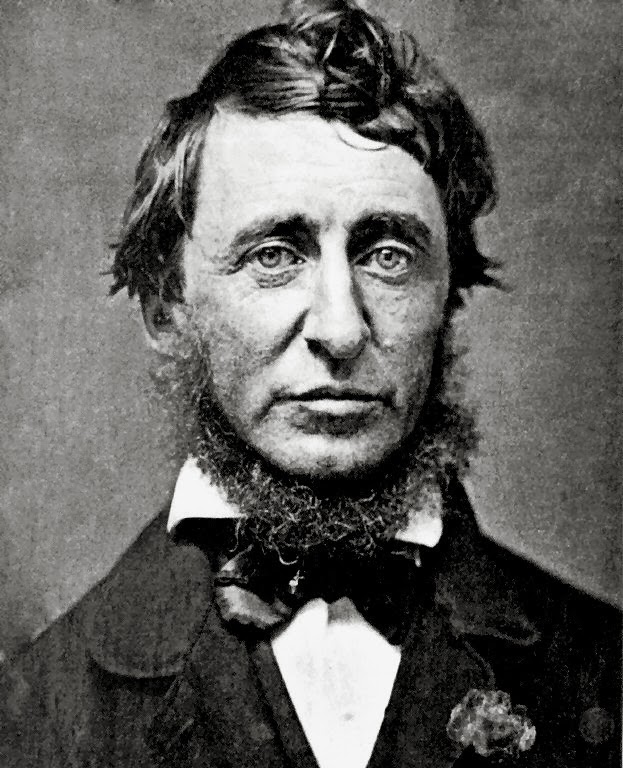
From the Wikipedia article. Portrait by Benjamin D. Maxham (daguerreotype) of Thoreau in 1856, just shy of his 39th birthday. Wikipedia says it might be copyrighted, so, so will I, but it seems like after 150 years or so, a copyright would have expired, no? 

About Me

My photo
I started this blog in September, 2006. Mostly, it is where I can talk about things that interest me, which I otherwise don't get to do all that much, about some remarkable people who should not be forgotten, philosophy and theories (like Don Foster's on who wrote A Visit From St. Nicholas and my own on whether Santa is mostly derived from a Norse god) and analysis of issues that concern me. Often it is about books. I try to quote accurately and to say when I am paraphrasing (more and more). Sometimes I blow the first name of even very famous people, often entertainers. I'm much better at history, but once in a while I see I have written something I later learned was not true. Sometimes I fix them, sometimes not. My worst mistake was writing that Beethoven went blind, when he actually went deaf. Feel free to point out an error. I either leave in the mistake, or, if I clean it up, the comment pointing it out. From time to time I do clean up grammar in old posts as, over time I have become more conventional in my grammar, and I very often write these when I am falling asleep and just make dumb mistakes. It be nice to have an editor, but . . . .